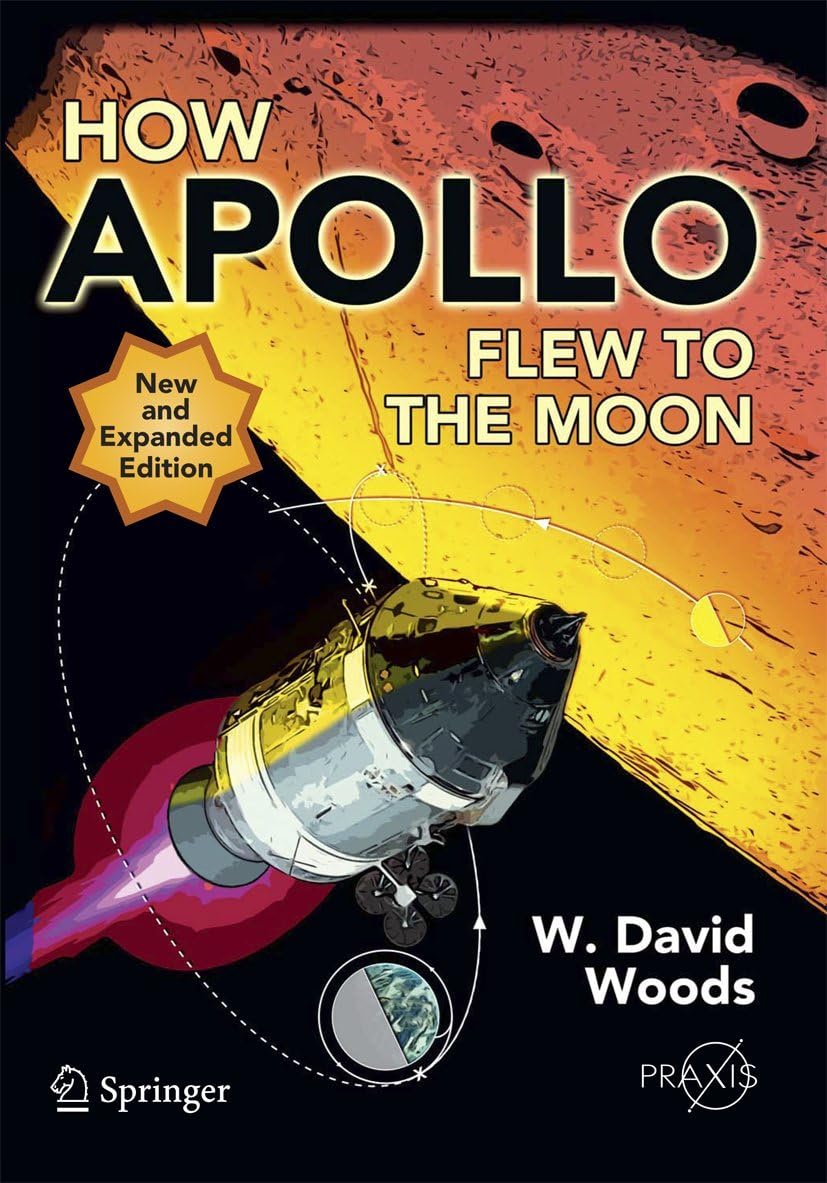
How Apollo Flew to the Moon (Springer Praxis Books)
Product ID: 54175866
📚2nd edition with expanded content
📸Hundreds of rare photos & diagrams
🚀Complete Apollo mission breakdown
Desertcart purchases this item on your behalf and handles shipping, customs, and support to Tunisia.
🌕 Unlock the ultimate insider’s guide to humanity’s greatest leap!
How Apollo Flew to the Moon (2nd Edition) is a meticulously detailed and accessible chronicle of the Apollo missions, combining technical insights, astronaut testimonies, and rare visuals. Authored by David Woods with a foreword by Apollo 15 Commander David Scott, this book offers an authoritative, richly illustrated journey from Earth to the lunar surface and back, making it essential for space enthusiasts and professionals alike.
| Best Sellers Rank | 415,208 in Books ( See Top 100 in Books ) 22 in Solar System 59 in History of Engineering & Technology 217 in Astronomy (Books) |
| Customer Reviews | 4.9 out of 5 stars 305 Reviews |
A**N
David Scott wrote the Forward ........(Apollo 15 Commander)
Because these `independent' reviews are so useful I thought I'd do mine. `How Apollo Flew to the Moon' is given instant credibility because Apollo astronaut David Scott wrote the Forward and for space fans do you need to know anything else? It follows a complete Apollo mission and is written like a text book in that the Chapters contain lots and lots of `sub' Chapters which enables you to read a bit, put it down for a while and then easily pick up the story up again. I can get lost and bored with some books but this is immensely readable. It is an excellent book if you like all the Technical and Engineering information about all the hardware and has lots of sketches photographs and photos astronauts took on the moon. But don't be put off by that because there are loads and loads of the conversations between the astronauts as well! Something I've always wondered about is how from blasting off the moon the Lander was able to find the Service Module? Well all the information about navigation trajectory and burns is here. There are even two pages of definitions for all the LM computer programs. Most importantly there are loads of new facts, like I never knew they carried a radioactive cylinder which was taken off the outside of the LM on the moon and then placed in the ALSEP so providing its electricity. Finally and most importantly if you ever have those tiny (2.am and in bed) nagging doubts like "did we really go to the moon?" then this emphatically answers the question. America DID put a man on the moon, who walked about its surface and then came home safely........not for the idiots who think it was all a hoax!
P**S
With diagrams and hundreds of photos it is an absolute joy to read and has given me an unbelievable amount ...
I've been interested in Apollo since I was a kid and have read a number of books on the program over the years. Each one made me long for something else that was just out of reach regarding the subject. I didn't ever expect to find a book that would cover the things that I had questions about. Or even have answers to questions I had never thought of. But - this is that book. "How Apollo Flew to the Moon" takes one of the most complex undertakings in the history of civilization and makes it graspable. It explains everything from the types of film in the cameras onboard to the wheels on the lunar rover. With diagrams and hundreds of photos it is an absolute joy to read and has given me an unbelievable amount of new insight on a subject I have read about for years. (Who could wish for more from a book!) The author obviously knows his material but more importantly he knows his audience. He keeps the technical jargon down to a minimum (which is quite an accomplishment considering the subject) and lends a human dimension when explaining very complex ideas and mathematics. This is the nuts and bolts of how the US put men on the moon - from Kennedy's proclamation to splashdown - and as far as I know it is the best book available when it comes to explaining it. Essential reading for anyone interested in the Apollo missions.
G**Y
Fantastic book
A very in depth description of the whole Apollo program with some amazing insights into how NASA solved the inumberable problems of achieving the goal of 'getting a man to the moon before the end of the decade'.
S**N
Fascinating, informative and detailed.
If you are (like me) fascinated by the subject of Apollo, you will NOT be disappointed by this book. It's packed with information that I hadn't known about before and is extremely detailed and accurate about how this remarkable event in history was achieved. Not so much why (cold war, politics, Kennedy etc) but how. The methods NASA invented to overcome certain obstacles were often remarkable (and occasionally rather Heath-Robinson) and they are all revealed here in fascinating detail. It's highly technical in parts but don't be put off, Woods is a good explainer. Now I've read it, I shall use it to refer back to, almost like a reference book. Thoroughly recommended.
M**H
If you are interested in the moon landings, buy this book!
When this book was recommended to me, I was worried that it would either be too superficial to be interesting or too detailed and complex for me to understand. In the end, it was neither. The author explains every detail of the preparations and all the journeys to the moon in concise, easy-to-understand sections. The myriad of photos are excellent. I cannot recommend this book highly enough.
R**R
An absorbing read.
Terrific read if you lived through the Apollo era or are interested in space flight. It takes you though every stage of a mission - and as you read this one's appreciation of the risks the Apollo team confronted simply grows and grows. It provides a great insight into the technology employed, and the critical design parameters - and then what it was like on board or in mission control as the missions progressed. An absorbing read - if you like this sort of thing!
M**E
Fascinating book
Loved the detail in this book, explains how they managed to achieve this amazing feat. Lots of tech detail which might be too much for some but just what I wanted. Thoroughly enjoyed reading it
J**N
Amazing
I don't normally write reviews, but this book deserves one, because it's simply amazing. It is crammed with detailed information that is technical enough for geeks to appreciate but explained so well that most laymen would have no problem interpreting it. Everything is described in detail, from the architecture, the methods and procedures, preparations, systems, checklists, navigation, launch sequence, rocket science, orbital mechanics, TLI, LOI, TEI, the vehicles, the landing, rendezvous and reentry. His prose is exceptionally clear and concise - it has to be because there's so much info to communicate. I loved the examples, anecdotes and excerpts from the voice track. This book is worth every penny, in fact i'd call it a bargain! Well done Mr Woods, sterling job sir.
A**M
A must-read for any fan of space exploration
One of the best books I have ever read. It covers the technical and operational details really well. A must have for any fan of space exploration.
M**.
Il migliore tra quelli letti
Il migliore tra quelli letti, leggibilissimo e scorrevole, ricco di dettagli tecnici ma non è un arido manuale, è un dettagliatissimo racconto della missione Apollo, con immagini importanti, disegni tecnici e spiegazioni di fisica. Raccoglie tanti altri libri letti, alcuni che non invogliavano a continuarne la lettura. Vorrei un libro simile sullo Space Shuttle. Da leggere assolutamente!
S**R
A must read for any space buff
I was 10 years old when Apollo 11 landed on the moon and I've been a space buff my entire life. This book is by far the most informative essay on the Apollo program I've ever seen. Enough detail for the technically inclined interspersed with some amazing human narrative. I learned so many things I never knew about the missions and the technology of the spacecraft. An absolute must read for anyone even moderately interested in the space program.
M**I
The book has a fantastic (and now dog-eared) abbreviation appendix and while I was ...
I have a casual interest in space. I'm not a professional but am fascinating by processes and decisions, how things work. This book covered the type of details related to pivotal decisions in the Apollo Program which get glossed over by more accessible books. For example, how the Apollo Program reached a decision to use 1) a really big rocket, 2) a earth orbit rendezvous or 3) a lunar orbit rendezvous is presented. That type of detail, the people involved and the thought behind each of the proposals was discussed and provide important and fascinating context to the following chapters. The book has a fantastic (and now dog-eared) abbreviation appendix and while I was more fascinated by the early Apollo missions instead of the final scientific missions, Mr. Woods does a fantastic job of relating the scientific importance of the latter Apollo missions. Mr. Woods also does a fantastic job of adding incremental detail to equipment usage such as the guidance computer. Instead of spending an entire single chapter on what the computer does and then referring to it in another chapter dedicated to periods of flight, he introduces the guidance computer early as a more general overview. Then, at moments when it is being used he walks through the detail of how it is used at that moment. Again, the way he does this is perfect. It is contextually relevant to the stage of flight he is describing and his method helped me understand details in equipment operation which I'm certain I would have glossed over had he approached it any other way. The book is chronological but he uses various Apollo programs and the events that occurred during those flights in a way doesn't feel like he's skipping moments. While the flights were different, large macro-type events in each timebase were somewhat similar and Mr. Woods uses examples in ways which make each timebase stand out. I honestly loved this book. My only issue with the book is the scant photographs and somewhat smallish schematics. To augment his descriptions and some of the books photos, I purchased the Saturn Rocket Haynes Guide and spent time on the internet looking for additional detail. The images in Mr. Woods book were fantastic, to be sure, but I wanted more. I realize a book of this size has limited space and as a result I'm certain there are photos the author and others reluctantly had to discard so this does not detract in any way from his work. The Haynes Guide provided some additional important details about the saturn rockets which helped visualize their immense scale and the internet provide the ability to look at larger schematics of items such as the guidance computers.
S**E
Great reading.
Essential reading for anyone interested in the Apollo Space Program
Trustpilot
1 month ago
2 months ago