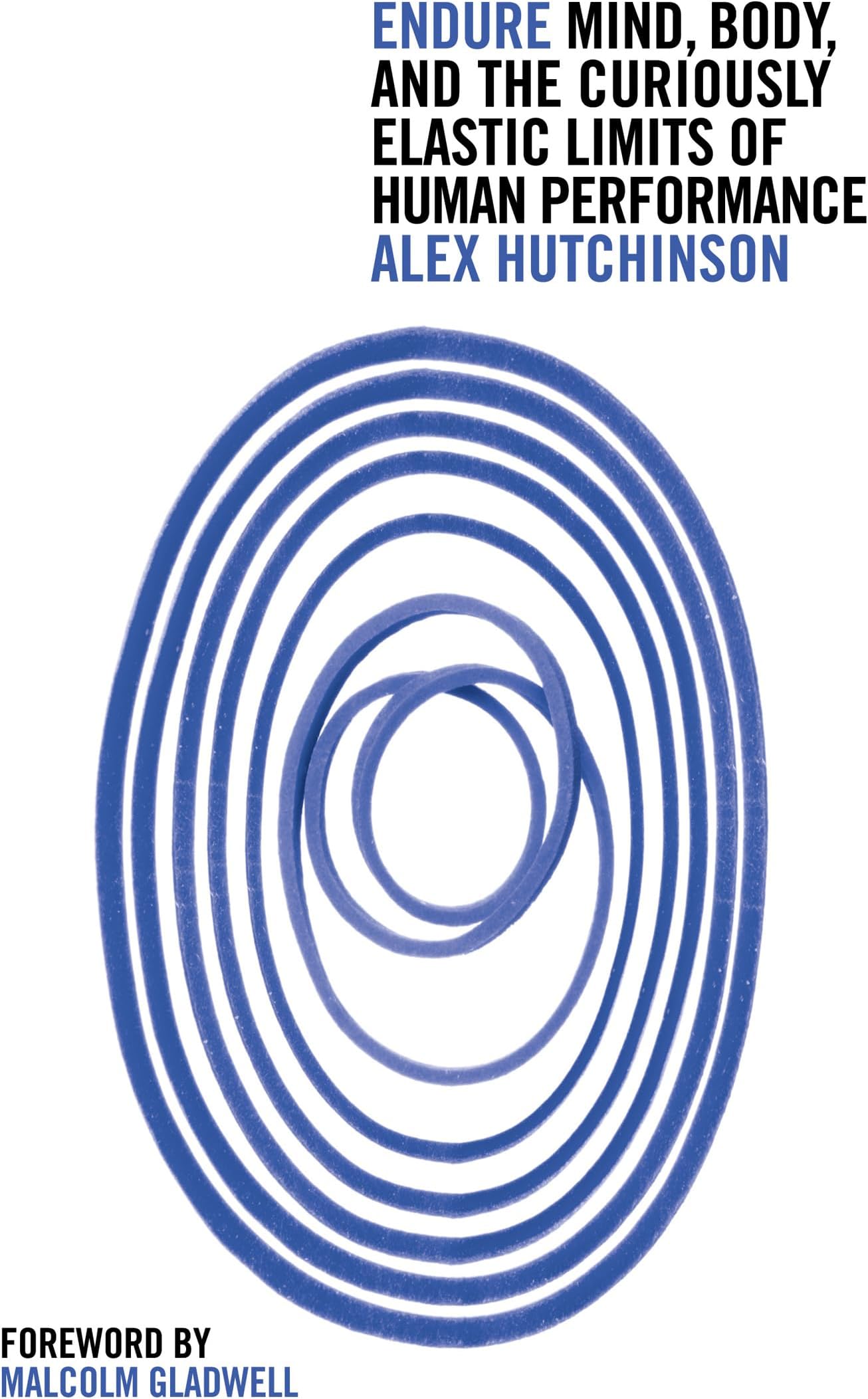
Endure: Mind, Body and the Curiously Elastic Limits of Human Performance
Product ID: 64816659
This book is amazing ’ Malcolm Gladwell ‘if you want to gain insight into the mind of great athletes, adventurers and peak performers then prepare to be enthralled by Alex Hutchinson's endure. ’ – Bear Grylls How high or far or fast can humans go? And what about individual potential, what defines a person’s limits? From running a two-hour marathon to summiting mount Everest, we’re fascinated by the extremes of human endurance, constantly testing both our physical and psychological limits. in endure Alex Hutchinson, ph. D., Reveals why our individual limits may be determined as much by our head and heart, as by our muscles. He presents an overview of science’s search for understanding human fatigue, from crude experiments with electricity and frogs’ legs to sophisticated brain imaging technology. Going beyond the traditional mechanical view of human limits, he instead argues that a key element in endurance is how the brain responds to distress signals whether heat or cold or muscles screaming with lactic acid and reveals that we can train to improve brain response. An Elite distance runner himself, Hutchinson takes us to the forefront of the new sports psychology brain electrode jolts, computer-based training, subliminal messaging and presents startling new discoveries enhancing the performance of athletes today, showing us how anyone can utilize these tactics to bolster their own performance and get the most out of their bodies.
| Dimensions | 15.3 x 2.4 x 23.4 cm |
| Isbn 10 | 0008277060 |
| Isbn 13 | 978-0008277062 |
| Item Weight | 420 g |
| Language | English |
| Net Quantity | 322.00 Grams |
| Print Length | 320 pages |
| Publication Date | 28 February 2018 |
| Publisher | HarperCollins |
| Reading Age | 12 years and up |
User
Must have
Awsome book. A must read
User
Good for researchers
Excellent information. Good read, mainly for researchers.
User
Why to read?
Very nice book to gain confidence to rebuild
User
To help you reason why run extra miles!!!
Great book, if you are into running, or any exercise for that matter, this may turn out to be an amazing change in the way you think about your routines.It takes time to absorb this, but it's the easiest way i think this could have been explained, a journalistic piece at core that reminds you the boon that they are to laypersons...I recommend this for any sports enthusiast...Even other high demand workers can get some lessons out of it...
User
This Will Change The Way You Push Yourself
Unlike other books, Endure does not tell you about how you can get faster, stronger and cross that finish line pain free. In all honesty, this is the book that tells you the WHY of pushing yourself hard towards the end of any race, any sport. This book is reason I was able to do a half marathon with ease, considering my only comfort zone are the 100m, 200m races. Would highly recommend this book to anyone who's looking for a reason to push themselves and still have a smile on their face.
User
Scientific and well written.
Very interesting look into the factors guiding human limits in endurance events. Thoroughly enjoyed the book and took away a good few things to apply to my own training.
User
Worth a read
It’s a great book with a lot of insights on research done on training across the globe. You must read it once to understand what all goes through your body while playing an endurance sport. It will help remove a lot of myths that you might be having. However there are very few learning’s that you can incorporate in your real life training which disappointed me quite a bit.
User
Best book for Self improvement
Good book for book lover and enthusiast for self improvement..
User
Great book for endurance athletes who want to learn how the brain influences performance.
What a great read. It's a real page turner if you are an endurance athlete trying to learn more about how your brain influences performance. Alex is an excellent writer and brings a real passion for endurance athletics to this book. This is a balanced and scientifically sceptical view of how athletes, science and corporations like Nike and Red Bull are pushing the boundaries of human performance. The hook for me was the story of the sub 2 hour marathon attempt from 2017 that was spread throughout the book.
User
Great book
Really interesting. Chapters can be read standalone
User
Fascinating insights about human physiology at the limits
This is one of the most fascinating books I have read in recent memory. Hutchinson, writing in a style reminiscent of Malcolm Gladwell (who actually wrote the book's foreword) or Freakonomics investigates how the human body works and how it can be pushed to its limits - or beyond what we often perceive as our limits. The book was initially inspired by the chase to run a marathon in under two hours - a conquest many believe to be beyond the limits of human capability. The record has since been broken, but only in a very controlled and optimized setting, leaving questions remaining, but opening the door for the possibility much wider than previously considered. This is one of many principles Hutchinson looks at to bridge where psychology and physiology interrelate to define our limits. Once something is proven to be possible, it suddenly becomes attainable to a far wider audience; this is one of the clear psychological barriers. While the book does not definitively conclude how much is mind vs how much is body in defining limits, it clearly uncovers that the mind plays a much larger role than we like to give credit. Hutchinson references, and indeed observes, many ingenious studies aimed to identify what the true physiological limits are - from explorers in wild conditions, to elite athletes, to living and dead animals having their muscles stimulated by electrical currents. One of the central pillars is that the human body has many self-regulatory systems that act as a governor to keep us from approaching anywhere near our actual limit. As one of many examples, he considers the limits of oxygen deprivation. By looking at ultra free divers, a familiar pattern emerges that they must psychologically manage. Holding one's breath for an extended time begins with discomfort, a signal to the brain that oxygen is needed. If one continues to avoid breathing, the diaphragm will begin to spasm to try to force a breath. If one continues to refrain the task actually becomes easier for a time and a second wave occurs allowing the extension of holding one's breath. This is because the spleen sequesters a cache of oxygenated blood to be released in case of emergency. The true limit is far beyond what most people consider because few will willingly push themselves to the point of the spleen anticipating death and offering a final boost (clearly, this is not something a normal person should strive for). There are obviously much more pedestrian examples like how, if racers are running all out in an olympic race, is it possible that most are able to increase their pace in the last stages of the race? Or why, if access to glycogen stores is critically important, do most top marathoners allow their glycogen stores to deplete over the course of the race rather than keep them topped up? Or, more psychologically, it has been revealed that rinsing one's mouth with carbohydrate rich solution and spitting it out has a nearly identical impact on performance to actually drinking it (the suspicion here is that there is an as-yet unidentified pathway from the mouth that signals to the brain carbohydrates are coming, allowing an override of the governor that would otherwise signal you to reduce your effort). There are dozens of studies, real world examples, and fascinating stories, backed up by the biology and chemistry of how it works, that reveal so much about how our bodies work in the everyday and in the extreme limits of exertion. All of it is remarkably digestible and written almost like a series of mysteries to resolve. Simply put: this is a brilliant, enlightening, and entertaining book that will teach you about the limits of that which we're capable and why, even if it doesn't necessarily provide all of the answers.
User
Satisfied
Great book
User
Une mine d’informations sur les limites du corps humain
Ce livre contient énormément d’informations sur la façon dont le corps humain utilise ses ressources pour courir, faire du vélo, grimper sur les montagnes, se démener et rester en vie. Il explique avec beaucoup de détails l’utilisation des hydrates de carbone ou des graisses pour réussir des exploits. Des informations très utiles pour comprendre comment notre corps fonctionne.
Trustpilot
1 week ago
1 month ago