Buy anything from 5,000+ international stores. One checkout price. No surprise fees. Join 2M+ shoppers on Desertcart.
Desertcart purchases this item on your behalf and handles shipping, customs, and support to Tunisia.
๐ฑ Unlock your gardenโs secret codeโtest smarter, grow stronger!
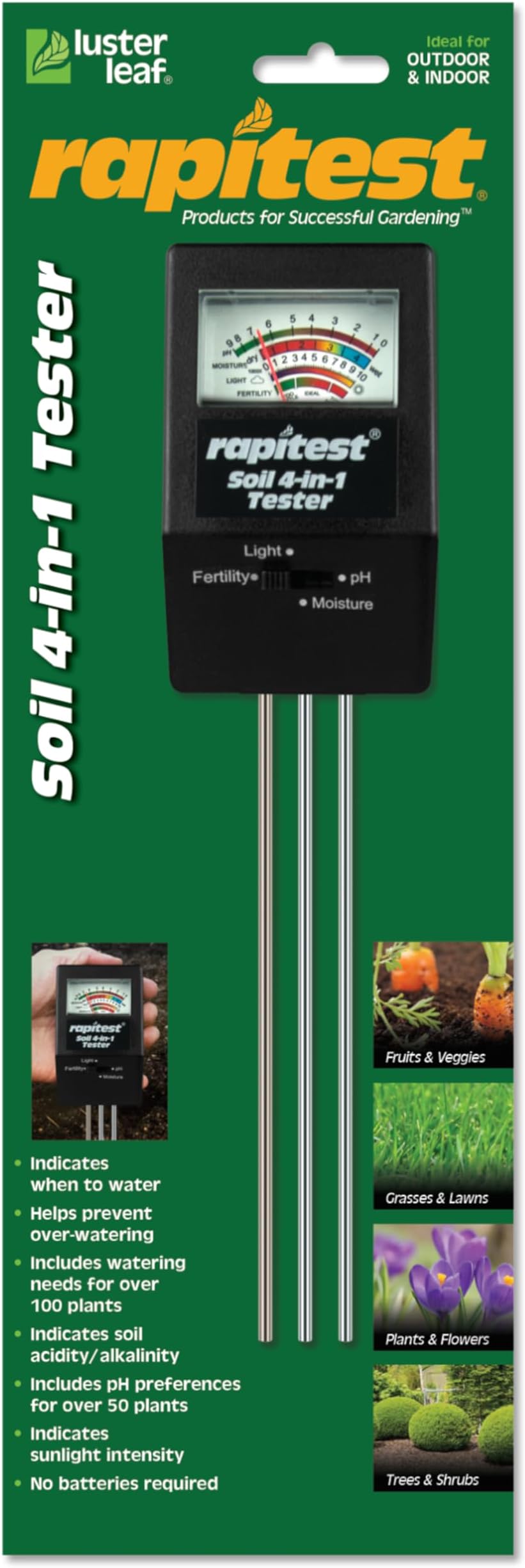
The Luster Leaf 1818 Rapitest 4-in-1 Soil Tester delivers fast, accurate readings of soil pH, moisture, fertility, and sunlight using three stainless steel probesโno batteries required. Designed for quick spot checks, it empowers gardeners to optimize plant health by preventing common soil issues, all in a compact, easy-to-use tool.
| ASIN | B000RUI9QK |
| Battery Description | No batteries required |
| Best Sellers Rank | #10,070 in Patio, Lawn & Garden ( See Top 100 in Patio, Lawn & Garden ) #8 in Soil Test Kits |
| Brand Name | Luster Leaf |
| Color | white |
| Customer Reviews | 4.0 4.0 out of 5 stars (966) |
| Global Trade Identification Number | 00035307018182 |
| Item Dimensions W x H | 1"W x 1"H |
| Item Weight | 0.2 Pounds |
| Manufacturer | Luster Leaf |
| Model | 1818 |
| Mounting Type | Tabletop |
| Part Number | 1818-6 |
| Smart Home Compatibility | Not Smart Home Compatible |
| Temperature Accuracy | 1 degrees_celsius |
| Temperature Reading Accuracy | plus_minus_1_degree_celsius |
| UPC | 035307018182 074994352025 |
| Unit Count | 1.0 Count |
| Upper Temperature Range | 122 Degrees Fahrenheit |
D**N
Economical, No Fuss, Instant Readings (5- stars)
As an avid gardener whose soil pH varies across her property, I really needed a convenient and quick way to test pH to ensure that the soil was properly adjusted. I tried those little vials with the test strips (economical but required a production to test more than one area) and an electronic gauge that required all sorts of solutions (accurate but a pain to use). With the Luster Leaf Rapitest mini soil tester, I finally found my perfect tester -- inexpensive, instant, and incredibly easy to use. All you do is select the type of reading you want (pH, fertility, moisture, and light), and insert the three-prong base into the soil. Right away, the needle sweeps over the gauge. You'll get the most accurate readings when the soil is moist and when you've left it in for at least thirty seconds to make sure the reading has stabilized, although most times a fairly accurate reading takes mere seconds. The fertility meter works fairly well; I planted some annuals in a pot of new Miracle Gro soil, and the gauge read on the high end of ideal, exactly what I expected. My vegetable garden, which I haven't yet prepared for this season, registered low, having been depleted of nutrients last year and over the winter. The fertility setting is good if you want a quick spot test to see whether you need to fertilize, although it's not plant-specific; different plants thrive on different levels of fertilizer, so you'll need to do your research. The moisture test is good for seeing if you need to water, but I assume that the probe measures only the moisture at the bottom, so, for shallow-rooted plants, take care that you measure at the lowest level of the root system, never below it. Deep-rooted plants might be suffering if just the top few inches of the soil are moist. The light meter is the least useful because it will only measure what is happening at the very second, something most people can tell for themselves. This device is not built for long-term use or for leaving in the dirt for more than a few minutes. The prongs are easily bent and should not be forced into rocky or compacted/hard soil (use a garden trowel to loosen the soil first.) For a more complete view of your plants/soil. minus pH readings, try EasyBloom Plus Plant Sensor . The Easy Bloom uploads long-term readings to your computer and provides plant-specific details; that device is not instant but instead takes readings over a minimum of 24 hours. I use the Luster Leaf primarily for pH and quick moisture tests, and the Easy Bloom for everything else. -- Debbie Lee Wesselmann
T**S
Great tool for hobby gardeners
For less than 12 bucks (at the time this review was written) you get a compact soil tester that measures pH, fertilizer levels, light and moisture - sounds like the kind of thing that is broken right out of the box or works once and then never again, right? Not in this case - the rapitest unit is relatively sturdy and appears to be made with some regard for quality. Of course, you should not expect it to survive many nights outside in the rain, nor will you get the kind of results that NASA would require for a zero-g botany experiment, but for a casual gardener with a few temperamental indoor plants this is a perfect little tool. It will give you a rough idea of how your little patch of soil is doing and can assist you in diagnosing why specific plants seem to be struggling. The most useful setting is the pH tester which gives a acidity/alkalinity reading without using testing strips or dyes. The fertility setting is calibrated for a specific set of ppm for N, K and Phosphorous (these are listed in the instructions) - also useful if you know the mineral requirements of your individual plants. The instructions included with the unit are printed on a single sheet of paper and are easy to follow. Step by step directions for using each setting are given. On a side note: I'm not going to risk cracking my unit open but my guess is that this device works by measuring the flow of electric current and bases the results on pre-calibrated resistances. This means there is a battery in there somewhere that will eventually conk out.
G**R
Following directions and some common sense are the keys to success, great gardener aid
As a gardener, testing soil for fertilizer and pH of course is a good practice and indicates the soils health for planting. I have raised beds so the soil is not walked on or compacted (lots of vermiculite, compost and peat keep it loose), but I also follow the directions carefully provided with the tester and use some common sense. To measure fertilization and pH that means removing the top 2" of soil and using rain or purified (distilled) water to make it a bit muddy and then putting the probes deep, almost to the bottom of the case, in the muddy soil. You polish the pH probe with the little pad (it is like a little piece of Scotchbrite) before inserting in the soil. You will see the pH level move a little if you wait and let it settle (30 secs +/-). Of course if you are just interested in measuring moisture there is no preparation, you just insert it in the soil up to the bottom of the case. If you soil is firm use some common sense and break it up! The probes are not intended to break through firm soil and are long, so you could certainly damage them. If you are primarily interested in measuring moisture I would get a moisture meter with only the one probe, the probes on those single purpose meters are usually thicker and that will also save wear and tear on the other probes and having to clean them off. I have both and use my moisture meter almost daily, the 4 in 1 less frequently to test my soil maybe once every 2 to 3 months or if I see a problem with my garden. In any case the directions don't recommend you leave the probes in soil for extended periods of time or put them only in liquids such as water or vinegar over night test it, as some have commented. If you want to check accuracy of the ph reading get a test strip or other type of pH kit to compare or take it to your county extension agent and they will test it. I think you will find the 4 in 1 does a fairly accurate job and with a little less hassel then some of the other kits/strips. Of course if you want to test the moisture, stick you finger in the soil, with a little experience you will see what the readings mean in terms of moisture. Ok so why only 4 stars? I wish the base and probes were two separate two pieces like some of the single measure probes (see Luster Leaf 1820 Rapitest Soil Moisture Meter or Luster Leaf 1840 Rapitest Soil pH Meter ). I think it would be easier to read since you could hold the meter closer. When you stick it in the garden, even a raised bed, the readings are well below eye level. I end up tilting it back a little when I insert it so it is easier to read, but the print is sort of small. Not a real big deal in the whole scheme of things and having the fertilizer and pH on the same meter is a convenience, saves a little money and means I have one less thing to haul around. However, if you are going to test soil well above or below your eye level you might want to consider getting one of the single purpose meters with the probe and meter separated. In my garden the moisture meter I use is the Luster Leaf moisture meter model I provided the link to and it is easier to read with the meter separate from the probe.
L**.
Not sure
Iโm not sure if it works 100%. I tested the Ph level of the soil of multiple potted plants. Every time it gives me the same reading of 7.0. If I test the moisture level I think it works. It gives me wet which is correct. So I donโt know. I think Iโll keep it since itโs inexpensive.
A**R
Helps to have healthy plants
Another product that helps me with my vegetable garden. Iโve tested it and gives accurate readings. Itโs still early in the planting season where I reside and Iโm just getting my plants into the garden beds and containers. Iโve had issues last year with the soil and this device will definitely help balance out any deficiencies in the soil.
R**C
junk
Got my 4 in 1 tester today. We had a good rain so I thought I'd take it to the garden and see how it would work right in the garden rather than a soil sample as per instructions. I have a raised bed garden so no rocks etc. are in my garden, just good soil. The first attempt worked pretty well, after letting it sit for a couple of min. Took it to another bed and got a good reading but when I pulled it out one of the probes stayed in the soil. By no means was it hard to place or remove from the garden soil. Good idea, bad product. Gave it one star because thats the lowest mark I can give it.
T**T
It works!
I have tried several PH testers through the years. I really cannot afford a really expensive one so I've always looked for one that works, which is reasonably priced. I tested three of them recently, locally purchased, and took them back. One of them would not even register vinegar as acid. Even some of the more expensive ones on Amazon get very mixed reviews, though I'm sure some of it is from not understanding how to use it and its limitations. I have recently started planting in clay and peat pots for later replanting outdoors when the weather gets warm. I like to check the soil PH for the various plants to make sure they get the right start. I then add what is needed to get the correct PH. I was able to do this without a hitch with the Luster Leaf tester, which is one of the cheaper testers on the market. When I test the PH, I take some soil in a glass and add filtered water to make thick mud. That is what I test. Just sticking the tester into the ground does not work very well. I checked the readings using soil which I knew to be high acid or base, such as soil with a lot of lime or acid added to it. It gave correct readings and changed as acid or lime is added. After checking to make sure this tester was working, I then tested my soil. Though I didn't have as much interest in the readings of soil nutrients, light, and soil moisture, I did try these readings and they seem to make sense. Much of the soil that I use has few nutrients to begin with. I always add something to the soil, manure, commercial fertilizer for flowers,etc. When fertilizer was added the reading changed accordingly. This seems like a good tester. At this point, having used it for only about 4 hours of testing, I recommend it.
M**K
Itโs worth the money.
It does what itโs supposed to.
R**N
Comments are true, It really doesnt work!
I read the comments, they all said it doesn't work, but i didnt believe it. I bought it and tried it myself to find out it really doesnt work. Returned it.
D**R
The meter is easy to use and is a great help to me
I had owned one of these from a different manufacturer before, but that one did not work. This Luster Leaf 1818 does work! I was particularly interested in moisture level. While making some mud to measure ph value, I also checked the moisture level of that same sample - the meter read full scale, which is just what I hoped it would. The meter is easy to use and is a great help to me.
A**I
PROBES ARE DISLOCATED IN CURRIER, ALSO ONE OF SCREW ...
PROBES ARE DISLOCATED IN CURRIER, ALSO ONE OF SCREW HOLDING PROBE IS SLIPPED SO PROBE IS DISLOCATED IN PACKAGE IT SELF. I MY SELF REPAIRED IT, BY REPLACING NEW SCREW ALSO SOLDERED IT. READING ARE SHOWING. STILL I TESTING IT.
K**M
simple unit means complicated measurements
It's not a Stick'and'Measure unit, soil needs to be separately prepaired to form some mud for measuring.
T**Y
well worth it
A great little device. It appears accurate enough when i tested it. Its is easy to use, compact and useful; no batteries required either. Took a little while to deliver but in my opinion worth the wait. The device can be applied to outside growing environments and indoor plants. There are similar cheaper products available, often these only provided hydration and Ph readings. Light and nutrient readings are worth a few extra pounds in my opinion
Trustpilot
5 days ago
3 weeks ago