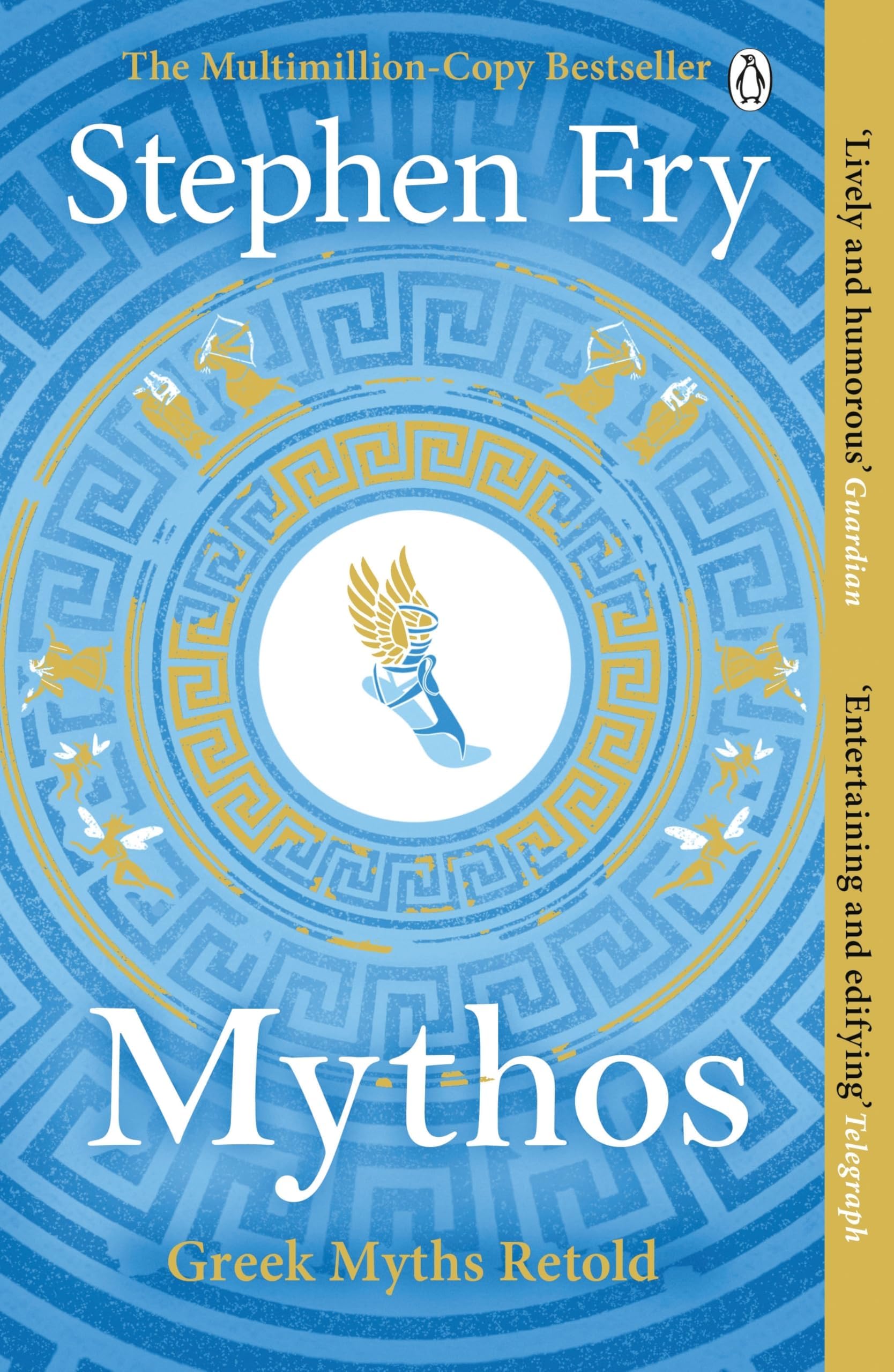
Mythos
Desertcart purchases this item on your behalf and handles shipping, customs, and support to Tunisia.
Description
⚡ Unlock the power of ancient gods—before everyone else does!
- CULTURAL PHENOMENON - Inspired a musical production and hailed by critics as an ‘Olympian feat’.
- DEEPLY HUMAN TIMELESS - Explore gods who love, quarrel, and deceive with boldness that resonates across millennia.
- AWARD WINNING BESTSELLER - Ranked #1 in Ancient & Classical History Fiction and shortlisted for a National Book Award.
- EPIC GREEK LEGENDS REIMAGINED - Step into the vivid world of Zeus, Athena, and Poseidon retold for today’s reader.
- IMMERSIVE STORYTELLING BY STEPHEN FRY - Experience mythic tales narrated with wit, charm, and modern relevance.
Mythos by Stephen Fry is a 464-page modern retelling of Greek myths, ranked top in its category and loved by over 22,000 readers. This first edition bestseller brings the drama, magic, and humanity of ancient gods to life with wit and timeless appeal, making it a must-have for anyone craving legendary storytelling with a contemporary twist.


Specifications
| Book 1 Of 4 | Stephen Fry's Greek Myths |
| Dimensions | 12.8 x 3 x 19.7 cm |
| Edition | 1st |
| Isbn 10 | 1405934131 |
| Isbn 13 | 978-1405934138 |
| Item Weight | 349 g |
| Language | English |
| Print Length | 464 pages |
| Publication Date | 26 July 2018 |
| Publisher | Penguin |
Reviews
User
A unique reinterpretation
I really enjoyed Frys collection of myths, reinterpreted into prose, and language easily digestible for a modern audience. He injects dry British humour throughout and his appendices providing background knowledge throughout were greatly appreciated.
User
Witty retelling of great Greek myths
Ancient Greek mythology has always fascinated me with all that beauty, chaos, pettiness, and drama but it's also previously confused me.Stephen Fry brings order to the madness. He gathers the best myths into a coherent narrative, adds a clear chronology, and shows how the gods connect, clash, and occasionally cooperate. It suddenly all feels readable rather than overwhelming.This is an easy, enjoyable book, helped massively by Fry's humour and wit. His retellings make the hierarchy of the gods feel accessible, without losing any of the grandeur or absurdity that makes Greek mythology so fun.My one niggle? The footnotes. I'm not a footnote person at all. They break the flow for me, and Fry uses them liberally. Not a deal-breaker, just a mild interruption.Overall, Mythos is absolutely worth picking up, especially with Christopher Nolan's The Odyssey now in cinemas.
User
brilliant read
Loved it, so many tales of the gods laid out really well, Stephen fry legend looking forward to the next 3 as-well.
User
Enjoyable travelling read
I found this to be an enjoyable book, well written and the stories and myths intertwined at times. Lots of names, I didn’t try to remember them too much, many you will be familiar with.It’s more a book of short stories than a novel.
User
Loved it!!
I really like how the stories were told. It made me think I went back in time and I was there.
User
Turgid
Sorry Stephen, I read the reviews, listened to the interview and then 'sampled' via Amazon. I was drawn in....but ultimately disappointed.I'll admit, I'm not a classical scholar, and found it hard to remember all the names and 'family' links outlined. I love the references to common words and uses in language today AND learning from the footnotes.But as a book, it just feels like a long old list of relentless, 'you'll remember' ...I didn't, and, 'as we know'....I don't, and yet more tales of gods and earthlings with names unpronounceable for the most part, and histories unrecalled at least by me. As a consequence, it feels disjointed and might be better if read as a book of short stories, though at times it's not clear where one story ends and another begins.10% in, I was enjoying it, by 20% I was enjoying the challenge, at 40% all relish has gone, I have no attachment to the characters. Sorry to say, this may be one of the very rare occasions where I simply give up and add it to the charity pile....But I'll read the footnotes before I do.
User
A modern spin on classic myths told in Fry's unique voice
I’m into mythology but so far have focused more on Norse mythology, so for a while I’d been wanting to read more of Greek mythology. I knew of the classic myths such as Pandora’s box, but the account of the creation of the world and of humanity was new to me and was fascinating. I found it especially interesting how many of the stories, recounted by Greek philosophers before the rise of Christianity, have similar biblical counterparts. While the book – as Fry states in the introduction – doesn’t aim to go into the meaning and interpretation of the myths, there were still intriguing historical and geographical comments that made me think. There are some modern references as he puts his own spin and humour into the classic tales.I found the book slightly hard to get into and concentrate on, for various reasons: I wanted to read all the footnotes as I was interested, but that did mean breaking off from the main text and losing the flow. Also, because of the nature of mythology being short tales and anecdotes, I didn’t get absorbed in the story in the same way you do with a novel. But, neither of these things reflect badly on the author, it’s just the nature of the subject. He did try to structure the book so that it is as cohesive and easy to follow as possible, but with mythology it’s never going to be a direct linear tale. The other thing was the sheer amount of names thrown in – it was impossible to remember who was who and who was the parent of who and what powers they had – but, again, I guess that’s just the nature of mythology.I would like to read the second book, Heroes, but I’ll have a break in between!
User
This is a must read for any level of subject knowledge
I absolutely love the fun and slightly cheeky style that this book has been written. You can really feel a personality jumping out of the, sometimes difficult to follow, Greek mythology. I enjoyed the additional footnotes and the original way of trying to install some what of a time line.
User
Fantastic Book
Funny and well written, an absolute must for any fan of mythology.
User
Probleem met het bekijken en ontvangen van mijn bestelling – Bestelnummer 404-4941000-3680360
Geachte klantenservice,Mijn bestelling met bestelnummer 404-4941000-3680360 wordt niet weergegeven in mijn account onder "Orders", waardoor ik de status van de levering niet kan doorgeven.Wilt u alstublieft zo snel mogelijk de exacte locatie van de levering aan mij doorgeven, aangezien het niet duidelijk is waar mijn bestelling is en ik deze dringend nodig heb.Alvast hartelijk dank voor uw medewerking
User
Sensacional
A releitura feita pelo autor é sensacional!!!
User
Funny, yet interesting
Such a nice book! I like how the myths were told with the author's comedic and funny storytelling. It is so interesting to learn how random things and concepts nowadays rooted from names of gods and goddesses. It's easy to understand and the words used are not that complicated.
User
An awe-inspiring accomplishment by the great Stephen Fry.
"Their myths understand that whoever created this baffling world, with its cruelties, wonders, caprices, beauties, madness and injustice, must themselves have been cruel, wonderful, capricious, beautiful, mad and unjust". The Greeks created gods that were in their image: warlike but creative, wise but ferocious, loving but jealous, tender but brutal, compassionate but vengeful". (Prologue)Stephen Fry is one of the most versatile and multi-skilled artists of our time and his work as an author, actor, producer, director, presenter, etc, has won both critical acclaim and people's deep respect. From a man of this stature, one could expect nothing less than bold artistic creations that dare to approach grand themes and subjects through an innovative perspective. In Mythos: The Greek Myths Retold, Fry attempts to retell the Greek myths, in chronological order, beginning with the existence of the primordial Chaos -the Greek equivalent to the scientific "big bang" theory- and the birth of the first order of divine beings such as the Nychta, Erevos, Gaia, Ouranos, Eris,and many others. These primordial deities were called the Titans, the word meaning "the striving, straining one", and the most notorious of them was Cronos, the titan who conspired with his mother to kill his father, Ouranos, and thus became the first among them. Cronos is known to the masses for the fact that he ate his own children to remain the king of the universe, but he finally took a taste of his own medicine as his wife, Rhea, deceived him and kept her last child that was called Zeus. Zeus grew up in Crete, far away from his wicked, cruel father and when he was in the appropriate age took revenge on his father and dethroned him from his regal status.As we are all well aware of Zeus was going to be the first among the twelve gods of Olympus, but this would not happen until this new order of divine entities, the second order, have removed once and for all the remaining titans from the face of the Cosmos. It should be mentioned that for ancient Greeks the word Cosmos meant what we call today the universe. What followed was a ten-year brutal war, an "earth-shattering conflict", known as the "Clash of the Titans" or "Titanomachy", and by the end of it, the Dodekatheon (meaning the twelve gods) was established as ruling the universe and everything in it. The new gods took the place of the titans through the use of excessive violence during the Titanomachy. Fry continues with the story of the creation of mankind by Zeus and the betrayal of Prometheus who stole fire and gave it to humanity as civilization. Zeus, enraged by Prometheus' treachery punished him severely as he was sentenced to eternal torment. Prometheus would be bound to a rock and each day an eagle would eat his liver which would then grow back only to be eaten again the next day. This process would continue ad infinitum. The reader can observe how the Greek perception of the creation of humanity shares many similarities with later religions like Christianism. One example would be seen as being created in the image of God both in Greek mythology and Christian tradition.Furthermore, we learn about the creation of the first woman, named Pandora, and her infamous box that contained a vast number of human vices that would torture mankind for the centuries to come. The author then mentions the story of the god Eros and his relation with Psyche. It is worth noting that ancient Greeks had four different words for love: Agape, Eros, Storge, Filia and each one of them had a distinct meaning. Eros was the son of the two Olympian gods, Aphrodite and Ares. Psyche was a lavishly beautiful young woman, daughter of a king, who made Aphrodite, the goddess of love and sexuality, to become jealous of her due to her incredible attractiveness. Eros fell in love with her and took her with him in an enchanted place where everything was dazzling, but under one condition. Psyche was not allowed for any reason to see her lover. But, as it always happens in Greek mythology, Psyche was unable to resist the temptation of looking at her gorgeous partner and attempted to light a candle to see him as clearly as possible when he was sleeping beside her. The result was that Eros, devastated by Psyche's betrayal, flew away from her. It was only after the intervention of the first among the twelve gods, Zeus, that Aphrodite became convinced to accept Psyche as her bride. There are more captivating chapters on the complex relationships that formed between gods and humans, the divine punishments, the metamorphoses of mortals to animals either as torture or as an act of compassion, and the great Greek lesson about Hybris that can be boiled down in this sentence: how pride comes before a fall.There are so many stories in this (mid-length) book that I was forced to incessantly keep notes during the reading. I have to admit that, even though I am a proud Greek, I remembered a tiny percentage of the stories cited in Mythos. In his foreword note, the author stresses his fascination with Greek myths as"the Greeks were the first people to make coherent narratives, a literature even of their gods, monsters and heroes"., even though their mythology is not the oldest in the world. The Greek gods owe a lot to the deities of Mesopotamia while the stories of Babylonians, Sumerians, and Akkadians preceded the Greek ones. Fry stresses out that his only intention is to simply retell the -already known- stories, and not to offer any kind of explanation or interpretation of their possible hidden meaning. There are some minor differentiations in their details, and Fry justifies himself by writing "in tinkering with the details I am doing what people have always done with myths". On another page, he quotes: "I think however that it is best told like all myths, not as an allegory, symbolic fable or metaphor, but as a story". Nevertheless, Mythos: The Greek Myths Retold attempts to establish a coherent timeline regarding the "ages of man" which is different from that of the Greek poet Hesiod who wrote the iconic Theogony. The readers who will read the book without skipping chapters will manage in the end to achieve some clarity regarding the chronological order of the genesis of both Cosmos, gods and mankind.In conclusion, I have to admit that this was by far the most compelling book I've read the last twelve months -or even more- and I cordially recommend it to everyone who has specific -academic or other- interest in Greek antiquity, mythology, literary theory and so on. Mythos doesn't require any prior knowledge on the subject and as the author writes in his foreword note: "You don't need to know anything to read this book; it starts with an empty universe". Stephen Fry is one of the most brilliant artists today and if you are not familiar with his body of work, then you ought to check him out immediately. He has also written another book, Heroes: Mortals and Monsters, Quests and Adventures, which is a kind of continuation of Mythos as in that book, the author dives into the world of ancient Greek Heroes. Some claim that those two books should be read in a row and I'm seriously considering starting it at once.
Common Questions
Trustpilot