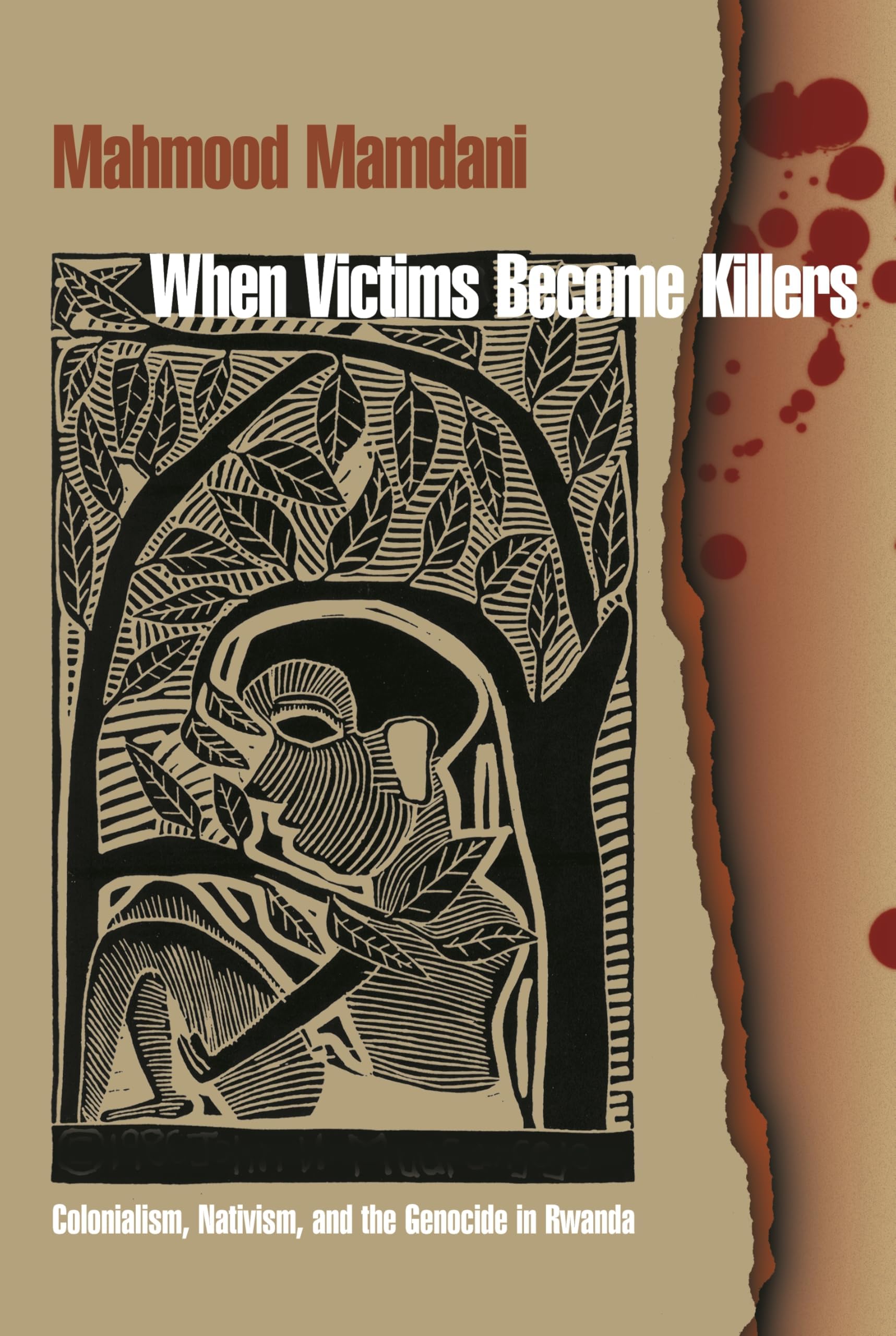
When Victims Become Killers: Colonialism, Nativism, and the Genocide in Rwanda
Product ID: 7512572
🌍Multilingual research scope
📚In-depth academic analysis
🔥Top-rated critical insight
📖 Unlock the untold truths behind Rwanda’s darkest chapter — be the informed voice in every conversation.
When Victims Become Killers by Mahmood Mamdani offers a profound, multilingual academic exploration of the Rwandan genocide, analyzing the roles of colonialism and nativism. Highly rated and ranked among top African politics books, it’s an essential resource for scholars and professionals seeking a deep understanding of this tragic history.
| Best Sellers Rank | #1,402,468 in Books ( See Top 100 in Books ) #38 in African Politics #70 in Colonialism & Post-Colonialism #311 in Non-US Legal Systems (Books) |
| Customer Reviews | 4.3 out of 5 stars 71 Reviews |
D**Y
Fantastic Introduction to genocide in Rwanda
Recently had to write a massive paper on the Rwandan genocide and this was a fantastic, academic book on the subject. Mamdani who was originally from a neighboring country, knew not only the native language of the Rwandans, but also knew French and English, allowing for his research to be extremely extensive. I recommend this book to anyone who is seeking a well put together prequel to one of the most savage genocides ever conducted.
F**R
Five Stars
Haunting and frightening
C**R
Seller provided correct in shape condition
Book arrived as it was described. No complaints
A**J
Should become the standard English-language introduction
This new book by Mahmood Mamdani, one of the world's most respected Africa scholars, stands a good chance of replacing Gérard Prunier's "The Rwanda Crisis" as the standard English-language introduction to Rwanda and its genocide. Mamdani's highly-readable account focuses on the political construction of Hutu and Tutsi as racial/ethnic identities, tracing the tale from the pre-colonial era, through Belgium's administration of the country, to the 1959 Revolution and subsequent attempts to develop an overarching sense of Rwandan nationhood. These attempts were cut short by the rise of Hutu Power in the early 1990s, culminating in the horrific outbreak of mass killing in April 1994. The advantage of Mamdani's book is that it offers "history from below," arguing that the racialized hostility between Hutu and Tutsi helps to account for the extraordinary (perhaps unprecedented) degree of popular involvement in the 1994 killing campaign. He also stresses the regional context of the Rwandan civil war and genocide, with separate chapters on Uganda and Congo/Zaire. The book is rich in theoretical insights but never ponderous or pretentious. A "must" for any student of Rwanda or modern African politics more generally (see also Mamdani's award-winning 1996 book "Citizen and Subject," which fleshes out some of the theoretical frameworks used in "When Victims Become Killers").
A**R
The Rwandan genocide explained.
It's a decent read,not as balanced as you might want. Good hsitorically.
H**A
When Victims become killers
A great book that is doing justice to the people that were rudely touched by the genocide. History plays a great part in influencing and explaining particular events that happen in the present but many people forget and view the event as inexplicable. Those who forget to ask the 'why' question are always liable to repeat the blunders of history since they never learn from its ugly mistakes. Prof. Mamdani is trying to undo this mistake. Many, especially in the west from their self righteous pedestal, look at the Rwandan genocide and judge. Mamdani goes behind the scenes of history to dig out the 'why' of this ugliest of human ventures. Drawing heavily on Franz Fanon, he casts a wide net covering the whole Great Lakes Region and Colonialism through the cold war, to tell us that the victims of injustice can only be free if they kill the oppressor. To become human they must deny life to the oppressor. The irony is, to overcome the monster of injustice, you must surpass its monstrosity, leading to the cycle of violence. Americans who read this book will come to understand better the whyness of 9/11; the Europeans will understand Hitler and Africans will grasp the whyness of so many coup d'etats, and finally an insight that is long overdue will dawn on us all and we will see the light. We will understand that without justice in the world those who work for peace labor but in vain. A must read book for serious peacemakers.
M**I
Book is terrible, honestly don't read pick another
this was a terrible book. it was bought for a class, which was equally as terrible. I would have loved to learn about the nyasa, but this book really turned me off. Mamdani leans too heavily on colonial history as the root cause of the Rwandan genocide, which can make the violence seem almost inevitable and downplay the role of more immediate factors like political leaders, propaganda, and state coordination in the 1990s. By focusing so much on historical structures and identity formation, he is also seen as softening individual responsibility, since perpetrators can come across as products of systems rather than people making conscious choices. His framing of Hutu and Tutsi identities as primarily political categories imposed during colonial rule is controversial as well, with some historians saying it oversimplifies precolonial realities and ignores the complexity of how people actually understood those identities. Others point out that his treatment of the Rwandan Patriotic Front is comparatively thin and less critical, creating an imbalance between long-term explanation and the specifics of how the genocide unfolded. On top of that, the book’s dense, academic style makes it harder to access, and some critics think his attempt to challenge conventional narratives about ethnic hatred goes too far, risking an overly abstract explanation that can feel detached from the brutality and immediacy of the violence itself.
D**W
Heavy Sledding
Respected scholar Mahmood Mamdani offers his take on the causes of the Rwandan attempted genocide of the Tutsis and how Rwanda ought to handle the aftermath. A longtime denizen of the ivory tower, Mamdani is not writing for general audiences here: his prose is denser than a nineteenth century Supreme Court opinion and often makes finer distinctions. There is a certain amount of this that is inevitable -- Mamdani is writing, at least partially, in response to people who have given facile explanations for the genocide (e.g. "the Hutus hated the Tutsis"), and his entirely justified reply is that it's not that simple. Mamdani makes a fascinating and very persuasive case for the exact historical causes of this particular genocide that differentiates it from other genocides of history -- colonialistic influence combining with pan-African political forces that pit nationalistic concerns against ethnic and political ones. That said, and with full awareness that I don't have the talent to do what I'm asking Mamdani to do, I'd like to say that his argument would have gone over a lot better if he'd been better at phrasing it. His academic language was very difficult to penetrate, even by a well-intentioned postgraduate-educated guy like me. I got to thinking towards the end that he was getting a bonus every time he added "-ize" to a noun to make it a verb. Mamdani's message that a lot of complicated problems combined to create the genocide -- from which it follows that people peddling simple, easy answers haven't been paying enough attention or are pandering to their audiences -- is important. I hope it is given deep consideration by the grad students who are best equipped with time and incentive to understand his prose, and I hope one of them figures out what I cannot: how to phrase his message in such a way that a lay audience will be willing to hear it.
E**N
Ottima opera di antropologia del genocidio
Chi vuole avvicinarsi al genocidio contro i tutsi in Ruanda, sotto il profilo antropologico, dovrebbe leggere questo libro. È pieno di spunti e riflessioni acute su come si sono evoluti i rapporti tra i due gruppi sociali nel corso del Novecento, periodo preso in considerazione dal saggio. Rapporti deterioratosi fino alla catastrofe del genocidio del1994.
え**た
植民地支配とネイティヴィズム
これはルワンダで起きたGENOCIDEに関してのアカデミックな書物です。単語の難易度が高く、TOEIC900程度のレベルでは辞書に頼らざるを得ません。文脈で理解するのにも限界があります。よって遅々として進まず、まだ20ページあたりを読んでいます。 しかしそれでも筆者の記している事は苦労して読む甲斐のあるものだと思います。ルワンダで起こった事は映画を通して知りましたが、それは私に強い疑問を残しました。それは普通の人々がなぜ100日で80万人もの人間を、しかも隣人をも無慈悲に殺戮するに至ったのだろうか、という事でした。その数にせよ、残虐性にせよ、想像を絶しています。部族が違うだけでそこまで憎めるものなのかと。しかしこの本ではこの悲劇をあらゆる観点から考察し、検証し、それを考え得る事だとしてしています。フツの人々にとってツチ族達は排除するべき外国人だったというのです。植民地支配や排外主義が大きな要因だとし、その考察は緻密に裏打ちされており説得力があります。 まだあと数百ページも読まねばならない私がレビューなど書くのもおこがましいですが、これからこの本を買おうと考えている方の参考になればと思い投稿しました。
R**S
no bias
a must read to understand waht happened from a neutral point of view. hightly recommened African history by an african
Trustpilot
2 months ago
3 days ago