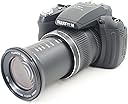
๐ท The powerhouse point-and-shoot that pros trust โ zoom, shoot, and own every frame!
The Fujifilm FinePix HS10 is a bridge-style digital camera featuring a 10MP BSI CMOS sensor and an impressive 30x Fujinon optical zoom lens (24-720mm equivalent). It offers a 3-inch tilting high-contrast LCD and an electronic viewfinder for versatile shooting angles. Equipped with triple image stabilization and a super intelligent flash, it excels in low-light and telephoto photography. The camera supports Full HD 1080p video recording with stereo sound and includes advanced features like high-speed movie capture at 1000fps and continuous shooting at 10fps. Lightweight yet powerful, itโs the ultimate point-and-shoot for professionals and enthusiasts seeking DSLR-like control without the bulk.
| ASIN | B0035WTVZA |
| Age Range Description | Kid |
| Aperture modes | F2.8-F5.6 |
| Aspect Ratio | 16:9 |
| Auto Focus Technology | Center, Continuous, Contrast Detection, Live View, Multi-area, Single, Tracking |
| Autofocus Points | 50 |
| Best Sellers Rank | #327,338 in Electronics ( See Top 100 in Electronics ) #2,871 in Digital Point & Shoot Cameras |
| Bit Depth | 8 Bit |
| Brand | Fujifilm |
| Built-In Media | Battery |
| Camera Flash | Built-In |
| Camera Lens | Fujinon 30x optical zoom lens, 24-720mm equivalent, manual focus, true wide-angle to ultra telephoto range. |
| Color | Black |
| Compatible Devices | Fujifilm FinePix |
| Compatible Mountings | Fujifilm FinePix |
| Connectivity Technology | HDMI, USB |
| Continuous Shooting | 10 |
| Customer Reviews | 4.3 out of 5 stars 187 Reviews |
| Digital Scene Transition | zoom |
| Digital Zoom | 2 |
| Display Fixture Type | Tilting |
| Display Maximum Resolution | 230,000 |
| Display Resolution Maximum | 230,000 |
| Display Type | LCD |
| Effective Still Resolution | 10 |
| Expanded ISO Minimum | 100 |
| Exposure Control | Automatic |
| File Format | JPEG, RAW |
| Flash Memory Bus Interface Type | SD |
| Flash Memory Speed Class | 10 |
| Flash Memory Type | SD/SDHC Internal |
| Flash Memory UHS Speed Class | UHS Speed Class 3 (U3) or higher |
| Flash Modes | Automatic |
| Flash Sync Speed | 1/250 or faster |
| Focal Length Description | 24-720mm |
| Focus Features | TTL (Multi, Centre, Area, Tracking, Continuous) |
| Focus Mode | Automatic AF (AF-A) |
| Focus Type | Autofocus & Manual |
| Form Factor | SLR-like (bridge) |
| Global Trade Identification Number | 00074101003789 |
| HDMI Type | Built-in |
| Hardware Interface | HDMI |
| Image Capture Type | Stills & Video |
| Image Stabilization | Sensor-shift |
| Image stabilization | Sensor-shift |
| Item Weight | 1.5 pounds |
| JPEG Quality Level | Fine |
| Lens Correction Type | Zoom |
| Lens Type | zoom |
| Manufacturer | Fujifilm |
| Manufacturer Part Number | HS10 |
| Maximum Aperture | 3.5 millimeters |
| Maximum Focal Length | 72 centimeters |
| Maximum Shutter Speed | 1/4000 seconds |
| Metering Methods | Evaluative |
| Minimum Focal Length | 24 millimeters |
| Minimum Shutter Speed | 30 seconds |
| Model Name | fujifilm FinePix HS10 |
| Model Number | B0035WTVZA |
| Model Series | FinePix |
| Optical Zoom | 30 x |
| Photo Sensor Resolution | 10 mp |
| Photo Sensor Size | 1/2.3-inch |
| Photo Sensor Technology | CMOS |
| Real Angle Of View | 62.2 degrees |
| Screen Size | 3 inches |
| Self Timer | 10 seconds |
| Sensor Type | CMOS |
| Series Number | 10 |
| Shooting Modes | Scene |
| Skill Level | Amateur |
| Special Feature | Lightweight |
| Specific Uses For Product | Travel |
| Supported File Format | JPEG, RAW |
| Supported Image Format | JPEG, RAW |
| Total Still Resolution | 10 mp |
| Total USB 2.0 Ports | 1 |
| Total USB Ports | 1 |
| Total Video Out Ports | 1 |
| UPC | 074101003789 |
| Unit Count | 1 Count |
| Video Capture Format | MP4 |
| Video Output | HDMI |
| Video Resolution | FHD 1080p |
| Viewfinder | Electronic |
| White Balance Settings | Auto |
| Wireless Technology | Yes |
| Write Speed | 10fps |
| Zoom | Optical Zoom |
R**E
Four and a Half Stars
Four and a half stars Just got my HS10 yesterday and what surprised me literally first is that it looks and feels like a dslr. The camera isn't big at all and is light. All this with an excellent and very potent lens. Having had many dslr and p/s cameras I was able go through the menu even without reading the manual (Fuji doesn't include the full hard copy of the manual except as a pdf file on the disk--my major complaint about the camera!). The camera is light and easy to use, responsive and simple. Actually, a joy to use and manipulate. Upon further using the camera zoom, the overhead flash does stick out slightly to encumber the use of focusing on the zoom ring. A person with small hands probably won't have much of a problem, but those with larger hands may find it annoying. But you get past that once you see how nice and accurate the zoom is. The lens is sharp all the way through focus without any fringing (all glass in the lens according to Fuji). I shot in raw and there was a short time lag of 2-3 seconds per shot. I haven't tried it in rapid/continuous shooting yet to see if it can fire off a few raw shots (yes, the camera will shot 6 consecutive shots!). The lcd screen is nice and large and colorful. The view finder while nice that it has an automatic sensor that detects your eye, the image quality there is average. I understand that both lcd and view finder only show 97% of the picture which makes you scratch your head. But nothing too bad. The diopter to the viewfinder sharpened nicely according to your vision. As I shot the images in raw, what struck me was how beautiful and rich the shots were. Some pictures even had me applauding. The zoom is fantastic and to be able to go from wide to full zoom in just a snap is wonderful. I've had dslrs and been lazy about changing lens. The convenience of an all-in-one lens is great. Camera image stabilization works nicely. I did notice that on aperture priority it only goes as far as f8, but in manual you can get f11. Another oddity. I would say that the HS10 is a mini dslr or dslr-like. The nay-sayers and nit pickers you see on the reviews here are being unfair, because they want some great Nikon/Canon dslr which in the end costs big bucks but for $500 with this kind of zoom, CMOS sensor, and many more features (panorama stitch mode, etc.) that the normal dslr doesn't carry, you can't go wrong. Later as I processed my raw photos I was truly impressed with the dslr quality of the images. The Fuji/silky software is slow but hopefully there will be something out better soon. Also, a firmware update by Fuji will easily enhance the camera's few foibles. (I forgot to mention that after first getting the camera and seeing the excellent results I then put on a tinted filter which affected the color saturation. I then purchased a clear lens filter and all the robust Fuji color is back. CLEAR FILTER IS THE WAY TO GO!) I do recommend this camera in its class as a high end bridge camera or mini-dslr! More positives than negatives! Read the positive photoblog review on the camera. Also check out the many photos I've included here on Amazon. Good luck to all. I'll try write later after I've gone through all the features. Third day out shooting I figured out the trick for when the camera doesn't want to focus, you must also set the camera in macro mode and that helps solidify the shot. The camera sees a close up and thinks its a macro so you must also set the camera to macro! As of April 27, Fuji has a released a firmware update for the HS10! Go to the Fuji website to update your camera performance. Good luck. A second firmware update has been issued for the HS10 on May 24, 2010. From my trying it seems that spotmetering allows for the best exposure and shot making. Without a doubt spotmetering is needed when at full zoom for distant shots to differentiate your subject lighting.
C**H
A great all around camera and value!
I've owned a multi-lens SLR for years, and my Fuji Finepix HS10 for about 3 weeks. I have taken about 300 test shots with it to test many of the features and functions as well as learning how to use it. Overall, I am very pleased with it. Image quality (IQ) is quite good, and it's fairly easy to use. The flexibility and number of features enables it to compete with basic DSLR's. Lens: The OPTICAL zoom range is incredible (24 - 720mm)in a single lens! The overall performance of the lens is outstanding. Having a 24 - 720mm zoom range, there is no need to change lenses. Yipee! Say good bye to lugging around several lenses, and having to change them all the time! Fuji has taken a lot of time to carefully design and engineer this camera. To get the most out of it, I've thoroughly read (and follow) the manual and have had great results. Most of the issues written by users I feel may be (IMHO) operator error; not following the manual. The manual however, could be somewhat clearer regarding some of the settings. Examples: Some of the settings / adjustments (ISO, White Balance, etc.) work only in modes other than Automatic or SR (which makes sense, but should be more clearly stated). Ref. page 49 "Autofocus Mode" - "Area" and "Tracking" modes work only when face detection is turned off which is not noted in the manual. Examples of what I feel may be user errors / comments: Battery life. NiMH batteries must go through 3 - 5 full charge / discharge cycles for them to operate at full capacity -this is why the camera has a battery discharge function! Brand-new NiMH batteries will not operate at full capacity until they have been discharged and recharged multiple times. I have found when the camera displays the red low battery icon, there is still significant battery life left; giving the user plenty of notice. I am using Sanyo Eneloop's which have 2,000 mAh capacity and worked great. Ergonomics / lens zoom & manual focus operation: I find the manual zoom ring near the camera body, and zoom function to be smooth and both are easily operated. The other controls are well placed and with practice can be used without looking. Write speed: I have found the shot-to-shot time to be fine. Be sure to format the SD / SDHC card IN THE CAMERA before use(again, read and follow the manual!)! Use "Class 6" or higher SDHC cards - especially for video capture (the "Class" number indicates the write speed - the higher the number, the faster the write speed). Also be sure to update the firmware when new versions are available (again, follow the manual!). The flexibility and control of shooting modes (fully automatic to fully manual), control of aperture and depth-of-field (DOF), shutter speed, sensitivity (ISO), white balance, color settings enables the HS10 to compete with DSLR's. Focusing: Generally, the camera takes sharp photo's, however at time I have found while in Auto mode, the camera may not focus on subjects when zoomed-in all the way. Switching to SR Auto puts the camera in macro mode and the camera will then focus. I've called Fuji to let them know. The camera should focus regardless of the mode in which it's operating. I like the chrome color setting for outdoor photo's - accentuates greens and blues. I have been a 3-lens SLR user for many years, and have found this camera was a great choice for me - a single lens w/ a 24 - 720 mm focal length range, a great combination of features, good IQ, flexibility, functionality, and at the price a great value!
J**N
Great "bridge" camera
I've had this camera for about 2 weeks now. I've never owned a DSLR but have used them from time to time. I'm the type of person that really enjoys all the technical aspects and full manual control and this camera fits the bill in that sense. I initially started looking at DSLR's but I enjoy taking photos while hiking, fishing, and at sporting events and so on. I just can't justify carrying around a bag of lenses to get the same range as this camera. So far I don't have any big complaints and am generally very pleased with the photo quality. Anything above ISO 800 starts to get a bit noisy but it's not a big deal (you can work around it) as long as you're aware of it. The lens is pretty amazing on this camera and I find myself taking pictures of things I never imagined before. The controls are pretty intuitive and I don't find myself saying "what were they thinking?" when adjusting settings. I've read quite a few reviews complaining about the manual focus ring being useless and hard to reach. Personally, I don't find it a problem but maybe I just have small hands. It's only something you use in the rare case the autofocus doesn't pick up properly anyway. For example, I tried taking some relatively close up pictures of a lit compact fluorescent bulb for fun. The autofocus seems to get confused in this case. The manual focus fixes the problem easily though. The other odd complaint I see in a lot of reviews is about the AA battery format. AA battery format was one of my requirements for a camera. I just don't see why I'd want to deal with expensive proprietary Li-ion battery formats when AA Ni-MH gives more than acceptable performance for a fraction of the price. And they're available everywhere. It seems like a no-brainer to me. There are a couple of things to be aware of that sort of surprised me. That's maybe my fault for not researching a little deeper. The impressive burst mode (10fps) is a bit cumbersome to get to and actual continuous fps is pretty slow. I guess I was imagining just being able to take 7 shots rapidly without having to activate the mode. My other complaint is about the RAW software. The ability to shoot in RAW is great but the supplied Silkypix software seems like it's halfway between full and trial versions. It supposedly has the ability to fix chromatic aberrations but this feature seems to be permanently grayed out (among others). I realize the idea is to get me to buy the full version but I'll likely just deal with jpeg out of lazy protest. PROS: -24-720mm (35mm equiv.) lens. And it's fantastic. -Manual barrel twist zoom. -Completely adjustable and manual if you want it to be. Sensible and practical auto and scene settings too. -Tons of neat software tricks and modes. Panoramic images, motion remover, low light modes, 1000fps video, etc. Some of them are a bit gimmicky but still fun. -AA battery format (some would disagree). -Great quality photos with a little practice. -Full HD video if you're into that. -RAW image format. -Threaded 58mm lens takes standard lens hoods, filters, etc. CONS: -Limited Silkypix RAW software. -High burst rate not as useful as it sounds on paper. -Slow continuous shooting speed. -LCD screen resolution is a bit low, but it tilts so it sort of cancels out right? -Auto switch between viewfinder and LCD is sort of irritating sometimes. I would recommend turning this feature off. -There is no printed manual included except for a useless "getting started" type deal. You have to get the pdf from the website or the software disc. Why go cheap on the manual for such an expensive product? SUMMARY: As close as you're going to get (for now) to a telephoto DSLR without carrying around a bunch of lenses. The lens is really impressive. I am extremely pleased with the purchase.
F**T
Real Life Review
People Like the HS10 -------------------- First off, this camera can be a fun camera to use and that's probably one reason why some people like this camera. I liked this camera initially but as time wore on there were just too many snags that ultimately gave me reason to return it. The Deal Breaker: False Battery Status -------------------------------------- The first one everyone will be familiar with is the false low-battery status message that this camera displays. Although freshly charged batteries were used, in less than an hour and fifty shots later, the camera shut itself down. The batteries were discharged prior to charging as per instructions, the battery selector was set to "N" for NiMh, and the rating of the batteries was 2000mah. Other HS10 users have been able to take 500 shots or more with this power rating so it isn't necessarily connected to higher mah ratings. Firmware 1.03 -------------- The problem for this bug was fixed in firmware version 1.02 but my camera was shipped with version 1.03. Yes, there is a newer version. But apparently, the old bug has resurfaced with 1.03 and the battery problem is alive and well. And no, you cannot downgrade back to 1.02 if you get a camera shipped with 1.03. As mentioned before new battery performance (NiMh) is only 50 shots and less than an hour of shooting time before the camera shuts down (at least on my HS10). This is the real deal breaker for me. I called Fuji USA and the techs were in total denial about this issue. "We never heard of a HS10 battery problem," was their response. At that point, they lost all credibility with me as well as my respect for their customer support. I'm not sure if all newly shipped HS10s exhibit this problem, but mine did. Be sure to take this into consideration if you are contemplating the purchase of the HS10. The HS10: The Good and the Bad --------------------------------- As far as all around performance, it has a nice range of in-camera effects, fair low-light shooting capabilities, and of course, the 28-720mm monster zoom lens. Its auto focus isn't always spot on when in macro mode, contrasty scenes and in the shade; the percentage of properly focused images was only 1 in 20 when shooting flowers in the garden with average zoom using the auto focus. The noise from images above ISO 400 can be a bit much and the overall picture quality is about par for the course. The viewfinder imgae is totally insufficient in size and my guess is that Fuji forgot to add the proper diopter lens to it to magnify the display properly. This renders the viewfinder virtually useless because it is small...really, really small. The Big Picture ---------------- The HS10 offers some interesting features for a certain demographic, and if you fall into the category of photographers that has primarily used point and shoot cameras, the HS10 offers you an interesting bag of tricks. There are bells and whistles on this camera and this may give you a certain amount of entertainment for a time. The slow motion video feature is virtually useless if you are planning to use the highest 1000fps setting because the frame size is only an inch or so in width (Fuji conveniently leaves this info out on their advertisements). Low light performance for outdoor shooting or overcast conditions will require bumping up the ISO to at least 800, but this is also where lots of noise starts to show up in photos. If the scene you are shooting is busy or you're zooming in, the auto focus won't be able to select the proper lock-on. For 4x6 prints, vacation shots, or informal picture taking, the HS10 may suit your needs while giving you the look of using a DSLR. Conclusion ------------ If you are seeking a camera that has a respectable battery life, good low-light capabilities, good auto focus, and good image quality, you may want to hedge your bets by looking at other models. Don't let the siren call of a 30x zoom lens lull you into its spell because it's the overall performance of a camera that matters. Perhaps the next iteration of the HS10 will solve many of the problems you have read about. But until then, make sure you do your homework by checking out as many reviews on this camera as possible as well as user experiences posted on the Internet. I was well aware of all the issues revolving around the HS10 but hoped against hope that they weren't all valid. In my particular case, and sadly, many of the concerns proved to be true. (Yes, I read the whole camera manual so no user error here. ;D) It's very possible that there are quality control issues surrounding the HS10 and it may just be a matter of getting one of the good ones. In any event, a throw of the dice is a little disconcerting in order to get a unit that works. Final Thoughts: FujiFilm USA ------------------------------ Fuji USA proved to me that they do not care about its customers when they have issues with their products; specifically speaking, the HS10. With this sort of support, or lack thereof, it made it apparent that FujiFilm will not back up its products once you purchase them. This is unfortunate because brand loyalty is destroyed and this will eventually hurt sales. As far as FujiFilm cameras, I won't be back.
I**N
I am not an expert, this is just an end user comment...
I am not an expert and I use mostly auto, SRauto, adv1 and adv2 mode. After testing it few days and compare it with my Samsung i6 compact camera (yes, it is cheap and old), here is what I found initially. The raw mode produces excellent outdoor image but poor indoor image (I guess it needs a lot of light and steady hands). The jpg is below average for outdoor and is very below average for indoor; its jpg processing adds a lot of noise!!! I took the indoor pictures with windows open in day light and with flash on. All jpg pictures are soft (very soft). It should not happen to a company with so much experience in camera. It is like a Ferrari car with a bad driver. However, its macro mode is excellent. When zooming to max. (even to a small object), the result is above average too. My Samsung drops its IQ a lot when it zooms to its optical max. I contacted Fujifilm and they told me that Samsung camera is able to set ISO down to 50 for my pictures and with less exposure time comparing with the same pictures I took with HS10. Since HS10 used longer exposure time, my hands were not steady enough to prevent shaking. This is why all my indoor pictures are soft. Samsung i6 has a slightly bigger sensor too. Usually, only the expensive cameras use bigger sensor. He told me to use the "P" mode and adjust the focus and sharpness. I experimented a few settings and now the pictures IQ are closer to the Samsung (still has more noise than Samsung). Here is my setting: = Mode: P = ISO: 100 (I wish I can set it to 50) = Sharpness: Hard = Tone: Soft (it reduces half of the noise) = Color: Hard (color is too light even at "hard", need to change white balance) = WB Fine Tune: +1 (R) , +2 (B) = When zooming to far object, I always set it to macro mode (not super macro) = Focus: Center. Always focus subject at center of the frame, press half of the button, compose the picture, then press the button fully. = Face detection: It works most of the time, but not all the time. I prefer not to use this feature. I use the above technique to focus a person's face before composing the picture. It means that I can't use most of the features on this camera (like the auto, SRauto, SP1, SP2, and adv) with good result for now. But I still decided to keep HS10 because of the following reasons: 0) Use AA battery! No more special charger! But I do have a 15 minutes quick charger for my 2000mAh NiMH AA batteries. I will carry one extra set with me all the time. If I don't buy HS10, I would buy Canon SX20IS, it uses AA batteries too with hot shoes. 1) To get a manual zoom len with this wide angle and zoom range, I need to pay for a real DSLR camera. And I need to carry two or three lens!! Too cumbersome for me now. 2) It would cost much more to do item 1 above. Not wise to do at this economy with less job security. 3) Once I tried the HS10 manual zoom len, I fell in love with it. It brings me back my old memory before the invention of digital camera. I used to own the 35mm cameras with manual zoom lens many years ago. It is harder to do a smooth zoom with video, but I don't take video that much with a camera. 4) The pictures IQ with the above "P" mode setting are "closer" to my Samsung i6 now. HS10 still has more noise but I can reduce it with software, printer, or printer driver. Also hope the future firmware can "fix" it. 5) Raw pictures are very nice if you don't mind the 15MB size. 6) Write time is fast now for jpg pictures after I do the following: - turned off red eye removal - say "No" to all save org. image items - say "No" to Image display option - only take 2 to 4 mega pixel pictures. I only print 4x6 pictures, I don't need more than 2 mega pixel. 4+ mega pixel picture is just wasting disk space and take more time to write. - also using a class 10 SDHC card (only $19.95 from Amazon with 5 items gift!) 7) Hot shoe! There are not many cameras in this price range with hot shoe. It is needed for taking group pictures! And I don't like those slave flash, they don't always work. Someone said the "raw+jpg" mode gives better JPG pictures, but it is taking too long to write 15MB raw files and I hate to waste space. I am also using the "Zeikos ZE-FLK58 58mm Multi-Coated 3 Piece Filter Kit (UV-CPL-FLD)" with HS10. Only $7.99 from Amazon !! All glasses. I don't see any difference in picture IQ when using the UV filter. No issue with focusing too. This is important to protect the big zoom lens. The CPL filter also works well. Now I just need an external flash for this camera. Any good suggestion to match this camera ? Thanks for those who replied me in the comment page. I posted the reply from Fujifilm in the comment page too. Keep shooting .....
D**.
Really good "bridge" camera
I've had this camera for less than a week, but I've enjoyed it so far. There is a lot to learn about it (or any sohpisticated piece of technology these days) but I did significant online research before my purchase so I'm fairly sure I got the best fit for my needs and budget. It is a relatively new model, and has all the "bells and whistles" in this $400 range. It does take beautiful shots (I've mostly used for pet pix so far). I got it for the extreme zoom (24-720mm equivalent to 135 cameras), back-lit CMOS sensor, and complete manual control, as well as many auto-assist modes. Another consideration was the hot-shoe for external flash - something not many cameras at this price have, which allows me to use a 30-year thyristor flash which still works quite well (plus the ability for slave units if I want). While none of my old film lenses are still usable these days, it's nice to know I can still re-use something... I already had an HD camcorder (Sony) for video, but it was very limited in what it could do for stills (4 MPixel and all auto - very little control). Plus, this one does 1080p video (the Sony is over 3 years old and only does 1080i). In sum, it has so many features (Panormama, 7-10 fps burst mode, great mix of auto/manual modes, huge zoom, jpg & raw, etc)that for under $400 it was a no-brainer. It's not perfect, has many drawbacks, but of all the various cameras I looked at and their reviews, this was the one for me. I'm very happy. Best of all worlds for the price... DV PS - It also has a nice heft and feel, and it looks real cool too... Pros: No camera (especially in this price range) does eveything perfectly, but the HS10 does more things better than anything else I could find after months of searching websites and reviews. It won't be everyone's cup of tea but it was best for my needs. *Amazing zoom ("super-duper" said PopPhoto) *Complete control - from fully auto to fully manual with everything in between - all the priority modes and a couple user pre-sets *Excellent color sensor considering all the other trade-offs - credit the backlit CMOS for this *1080p video is beautiful, and 29 minutes seems plenty for most applications - paid 2 1/2 times for a HD video camera (albeit 3 years ago) that only does 1080i *Low noise at ISO 400 or under for this small sensor *Does simultaneous RAW+JPEG *Hot shoe (although without TTL metering) for external flash (now I can finally re-use my old thyristor unit that's 30 years old and I thought was destined for the junk pile!) IN ADDITION to the built-in flash Cons: As above, everything has trade-offs *RAW+JPEG is very slow (maybe a faster card would help - using Class 4 now) *HDMI connection requires aftermarket cable which is fairly expensive - my video camera is no bigger than the HS10 and has a full-size HDMI output *USB/AV outs are proprietary (which is a common problem on a LOT of current electronics - cell phone chargers most notably, so if lost or damaged, there's only one place for replacement) *AC adapter, for use in uploading to computer, is also not included, and is probably relatively expensive *As others have noted, electronic manual is not very portable or convenient - but once you learn the camera, who needs it? Other Thoughts: The Fuji HS10 has a huge feature set for the money and fits my needs best. I do some close-up (macro) stuff and shoot miniatures, so the wide angle depth of field is important to me. But I also want to be ready for Pets, Kids and Sports when the occasions arise. I have yet to fully explore this thing (haven't tried the Panorama mode, which most of the reviews say is far from perfect). But again, it seems like a lot of camera for the money, with a wide range of desirable features and good color fidelity, and something I've not seen anyone else comment on - it's a handsome thing, looks good, nicely proportioned, and it just feels darned good in my hands...
E**N
A 5-Stars Bridge Camera
I've been using this camera for a month now. I think it's about time to share my review about it. I was looking for a bridge camera for a while after a recent trip to Disney World. With my old Nikon gears (D70+17-55mm+70-210mm+30mm...etc), bags, 2 toddlers, car-seats, stroller, I told myself not to do that again. I order this HS10 from Amazon, and received it within a week. I updated the firmware Ver.1.02 right away and have been using this camera pretty much everyday from then on. Here are my pros and cons. Pros: * 30X optical zoom: I can shot something that I was not able to. I screw in my Sony VCL-DH1758 Tele Conversion Lens try shooting moon with handheld just for fun. I got a great detail on it. * AA batteries: I use 4 x Sanyo Eveloop batteries with more than 500 shots. No need to get rip-off proprietary battery and no need to risk on those cheap 3rd party batteries from EBay. * Flash hot-shoe: I can use my Nikon SB-800 on it. No TTL, but for bouncing light, it works pretty well. * 3" tilting LCD: it's beautiful and very easy to use it. It's hard to see in on the bright sunny day, but you can use EVF when you cannot see clear on the 3" LCD screen. Some complaint about the EVF resolution is very poor, but it didn't bother me. I mainly use it to compose pictures, not viewing. * Pictures quality: This is the most controversial topic and has been discussed thousands time in DPreview forum. I found many people compare it to DSLR while we all know this one only has sensor size as little as regular P&S camera. For color, I LOVE the color. It looks so natural on the skin tone and very accurate out from AWB. Even indoor shots the color looks very nice. For the sharpness, I have to agree with most users. It's a little soft most of time. If you are a DSLR user and too use to sharp images, you will find HS10 disappointing. * Filter thread (58mm): Yes, so if you have any filters from your DSLR, you can use it. I especially like that I can use my Sony tele-convertor lens on it. Cons: * Slow shot-to-shot speed: Overall the speed is slow. I lower the resolution to 5MB on JPEG and seem to be acceptable. It is slow, but most P&S camera are slow too. * Barrel distortions: I found it very obvious on the wide angle. The proportions of people on the edge are distorted badly. * No lens hood: I found the lens hood is an optional item that cost another $13.00+shipping from Fuji's web site. * Useless advanced modes: They never work the way they claim they should. Motion remover, Panorama, multi-motion capture..., none of them works. * Price: The price dropped about $30 after the day I purchased. I agreed with others that it is a little over-priced, but I got a CitiCard deal to save $100 on this camera. Overall I like this HS10 and would give it 5 stars as a great bridge camera. Yes, it is a 5-Stars "Bridge" camera. It will not replace your DSLR and the size is not as small as your pocket P&S camera. There's no camera that can do-it-all. Photographer is no other than chef, painters...etc. I never see a chef with only one knife nor a painter with only one brush. You need to know your tool well to fully utilize it. I don't mind keeping it because I know what it can do and what it cannot. There's a trend that Camera manufacturers start putting bigger senor into P&S camera (Olympus PEN, Sony NEX...etc). If you have no immediate need of a bridge camera, I think wait a little longer, we will see P&S cameras with mega-zoom and DSLR sensor on them.
E**S
Sweet Emotion
As a Pro journalist who is mainly a writer, I needed to be able to take photographs to go along with my race reports. I had been using film all along when the digital revolution invaded my space. Since my bread and butter was in the words, and mags and papers often hired separate fotogs to take the pics, I was not about to spend 4-6 grand on a digital SLR camera, I stuck with my film SLR. I was on the hunt to get a smaller lightweight rig that could supplement my main camera and upon much research, fell into this camera. First off, I read where fotogs whose living depend on their pictures were in love with "the little camera that could." The non-detachable lens will reach out to an amazing translated 300mm zoom, it's quite impressive. Lenses zoom that far out will usually lose a tremendous amount of light, somehow Fuji makes this work and it takes terrific pics even at great focal lengths. And they won an international award for the lens design to prove it's righteous. The body of the camera looks and feel very much like a slightly scaled down SLR rig so owners of those won't feel any different. The camera's flash is useful only indoors or at closer ranges outdoor to fill in areas. It will NOT compete with the separate hot shoe flashes designed for SLR rigs. There are several program modes and the aperture, white balance, shutter speed and a host of other adjustments can be made to give the desired result or effect. The camera being digital has a mode where you can see the exact settings for a particular shot, or all of them if you so choose. It makes the Fujifilm a great teaching tool. I learned more from the camera itself than I could've in a class room. Best bet for newcomers or those not wanting to experimenting is to leave the rig on "P" for program and let the camera decide the settings. You can't go wrong with that. My only gripes as a motorcycle race journalist are shutter speed, and reset times. The camera will get a decent action shot but the time it takes the batteries to capture, process and save the picture, the next rider has flown past me. A higher quality SD card I'm told would help quite a bit but it still will never take rapid shots like a true SLR camera. It can be compensated for to a degree but compared to an SLR is is slow in that sense. All of the Pro reviews I read they said the same Im saying to you, it is THE top of the line "point and shoot camera." An 800 lb gorilla of a point and shoot, or a point and shoot on steroids if you will. All of the Pro photographers who chose thing thing use it for simpler shots, or when they want a lightweight alternative to bulky lenses and heavy equipment. Ive attached some picture to give you an idea of what you cam do with this amazing little camera. It has become "GO TO" rig when not at the races. This truly is the little camera that could.
H**S
Fujifilm FinePix HS10
I bought this camera on pre-order because I have had much success with the Fuji line in the past. This is a great camera even after four years of very heavy use. My only complaint with this camera is with the white balance inside very large rooms. It seems like a small issue, but for professional use, this camera is great for video and outdoor use, and for home photography, but in large halls, the white balance seems to turn to yellow.
Trustpilot
3 weeks ago
2 weeks ago