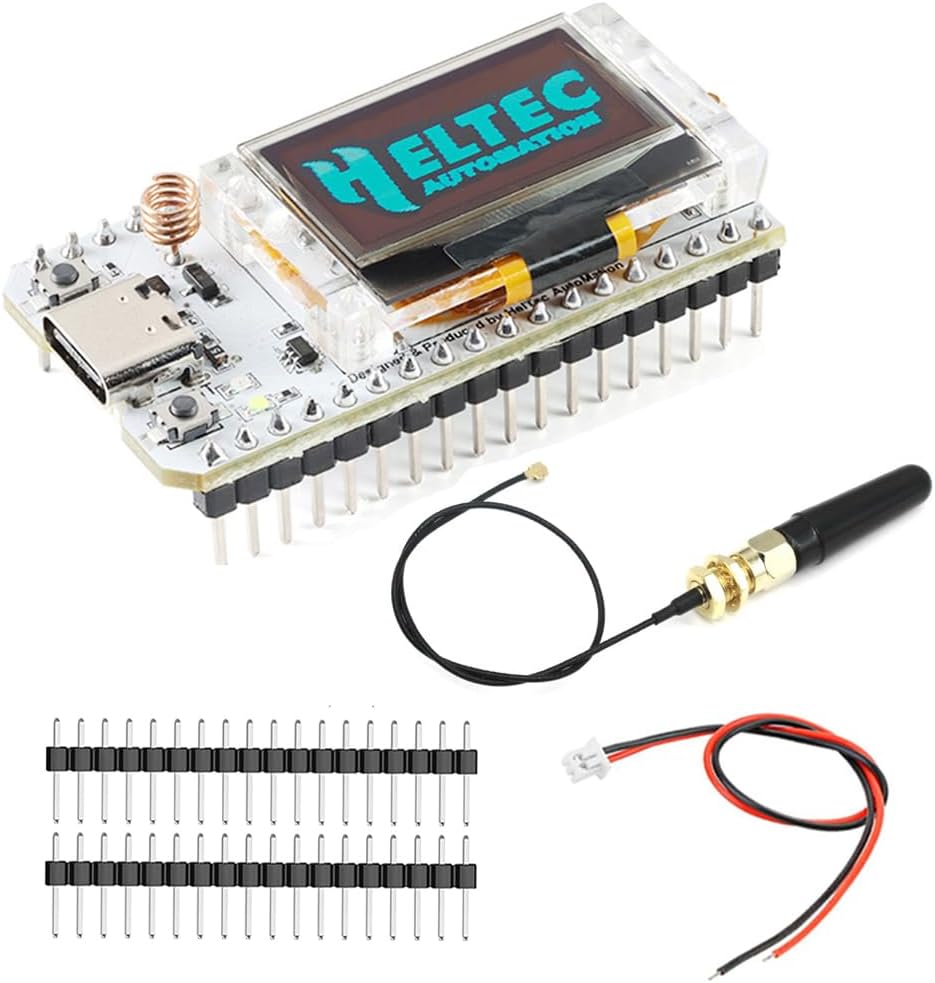
Desertcart purchases this item on your behalf and handles shipping, customs, and support to Tunisia.
🚀 Power Your IoT Vision with Next-Level LoRa Innovation!
The HiLetgo ESP32 LoRa V3 Development Board combines a powerful dual-core 240MHz ESP32 processor with the SX1262 LoRa chip, enabling ultra-long-range wireless communication up to 3.6 km. Featuring a 0.96-inch OLED display, integrated lithium battery management, and robust Type-C USB protections, this board is optimized for rapid Arduino-based IoT development and reliable field deployment.
| Asin | B07FYWFH4C |
| Best Sellers Rank | #1,146 in Single Board Computers (Computers & Accessories) |
| Brand | HiLetgo |
| Built In Media | ESP32 WIFI LoRa 32 V3 Development Board with OLED display, 433-510MHz Antenna, Pin sticker, 2 x Pin headers |
| Compatible Devices | Computers, smartphones, devices supporting Type-C USB, Arduino models |
| Connectivity Technology | USB |
| Customer Reviews | 4.3 4.3 out of 5 stars (111) 4.3 out of 5 stars |
| Item Weight | 1.12 ounces |
| Manufacturer | HiLetgo |
| Memory Storage Capacity | 32 MB |
| Mfr Part Number | 3-01-1495 |
| Model Name | V3 |
| Model Number | 8541612537 |
| Operating System | Linux |
| Processor Brand | Espressif |
| Processor Count | 2 |
| Processor Speed | 240 MHz |
| Ram Memory Installed | 32 MB |
| Ram Memory Technology | Flash |
| Total Usb Ports | 1 |
| Unit Count | 1 Count |
| Wireless Compability | Bluetooth |
User
A small esp32 board with a lot of features packed.
This review is for HiLetgo ESP32 LoRa with oled display board.The first impression of this board is that the oled is seated on a plastic base. That makes the board looks very well built and sturdy. The oled is a SSD1306 display with I2C connection which should be quite popular and easy to use. So far, I have tested wifi, the display, the built in hall effect sensor and touch sensor. They all working great. I used Arduino IDE for my testing and all the drivers can be found from the description of the Amazon product page. Last but not least, the back side of the board has a battery connection that allows to connect a lithium battery to power this board. One thing I didn't really try was the Lora because I only bought one board. I should have bought two of these boards. However, with that said, I am planning to get another one to try out the Lora functionality.Highly recommended !!
User
Remote godsend
This little board is amazing for building out projects that require low power (ie solar) and just can't be brought close enough to reach over wifi. The LoRa radio comes with the 433Mhz antenna which probably is the best balance for bands that you can operate on without a license for these types of applications. It has decent range but high enough throughput that it won't take half an afternoon to dump sensor data you are collecting.The JST and charging circuit do give you options to add some cells if you just plan on servicing the installation now and then.Finally, the OLED screen doesn't draw much power, but has plenty of real-estate to read out network stats, sensor readings etc if you need some feedback without hooking it up to a computer.The board boots up right out of the box and is compatible with several Arduino libraries if that's your preferred method of programming (see the attached video).Overall a great little board and for the price, it's hard to beat!
User
Well built, feature rich!
This dev board is like a toolkit! The ESP32 chip has pretty deep resources, so it supports extensive sketches (want GPS integrated with WIFI and LORA?) Upon opening, I was surprised at the quality of the product. I've had microcontroller boards before with poor solder joints, and unreadable masks. Not the case here. Everything was lined up perfectly, and the display is very cleanly integrated into the module. It even came with stickers for pin labels. Came pre-loaded with a test program which runs a wifi scan, tests the OLED, and sends LORA packets. After adding the Heltec board info and library through Arduino, I was able to immediately start uploading examples and start testing with bluetooth, wifi, and LORA.There are several GREAT write-ups online if you google 'heltec esp32 lora', although I never even needed to reference them, it was great to know I had a fallback.Great board, well built, easy to use, I will definitely be using more of these.
User
Antenna is my only complaint
I bought a couple of these to run Meshtastic.They work as expected, only issue is that the antenna that comes with them is not resonant on the correct frequency, so completely useless.Mine were both resonant around 433 MHz, so European LoRa frequency and not US.
User
ESP32 and LoRa - excellent combo!
If you are looking at one of these, then you LoRa is a recent wireless communication standard different from anything else on the market. It is not super fast, it is not WiFi, it is not cellular but what it is allows communication (supposedly) up to *kilometers* away, using line of sight. Realistically the best I've personally seen on other devices has been in the hundreds of meters, but I do know people that have used better antennas with some impressive results.Note that LoRa and LoRa WAN are two very different protocols.I've also used the M5Stack LoRa devices, as well as a few others both with and without displays. For taking a field trip, the on-board display is certainly helpful. There's only so much diagnostic information that can be sent out a blinking LED, unless and entire computer is lugged along.Some homework should be done to ensure the frequency used is actually allowed in your country, and take note of the actual "on" time. Some places restrict how often these devices transmit. At least in the USA, you probably don't want to end up on the FCC troublemaker list.I believe LoRa is meant for relatively low bandwidth, low volume data transfer. Period sensor readings are probably ideal. I've also read about some people setting up a mesh network to get even longer range. (I've not actually tried the mesh networking myself yet)
User
Check Compatibility
This is the new V3 version of this product that uses a new chip. There is nothing wrong with the module, but many of the current apps TinyGS, MySondy, etc will not currently run/load on this version and it appears version V2 is not longer available. Even most of the Heltec supplied examples will not load/run on V3. Carefully check the version supported by the app you wish to use.
User
Nifty board with extra features
Nifty little board. Like the other ESP32 boards it is easy to program via Arduino. It comes with a sketch flashed which detects local WiFi hotspots and it easily picked up mine and my neighbors' routers. The LoRa functionality is something I'd like to dig into.Two neat features about this board: The screen is mounted on a translucent standoff which makes it 0.2" proud of the circuit board. This is nice for packaging into a case for projects that need to look nice and clean. Some other boards have the screen flush to the PCB which makes packaging difficult without having the display recessed. Also, there's a battery connector on the back of the board! It is a Micro JST connector for lithium polymer batteries (3.7v). These are commonly used in small RC airplanes and helicopters. A quick Amazon search will find you plenty of options. The attached picture shows a typical battery with the right connector, and the board in operation under battery power.
User
QST article about weather radiosonde tracking
If you're intending to use this as shown in the QST article about weather radiosonde tracking, wait.First, here are some tips for success if you do order now:This can be flashed with the FW referenced in the article but you may need to use an alternate driver if you are running W7. (The so-called "Universal" CP210x driver on the Silicon Labs website is only for W10.Look for the one for older OS's called CP210xVCPInstaller_x64.exe on their website, which is really awkward to navigate, bt.)Don't waste time using an USB cable that is not made for data (seems obvious to say but take heed).I also used ESP32 Flash Download Tool to flash the firmware. The one in the MySondy documentation would not work for me.Also, be warned, the MySondy instructions have a lot of holes. But if I can do it, you surely can.BUT - the biggest problem with this whole setup is that the Weather Service (NOAA) is NOT using radiosondes in the 403 Mhz range throughout the nation. Many areas are still in the 1676 Mhz range and won't be upgraded till 2022-23.A contact I have at the NWS informed me of that when I called to find out why I heard - nothing on 403.QST did not vet this article well.
User
Works great
Works perfectly
User
Difícil de programación
No lo compren, muy malo, es muy complicado de programar, luego en operación se calienta mucho, el display se desvanece, mala compra
Trustpilot
1 week ago
2 months ago