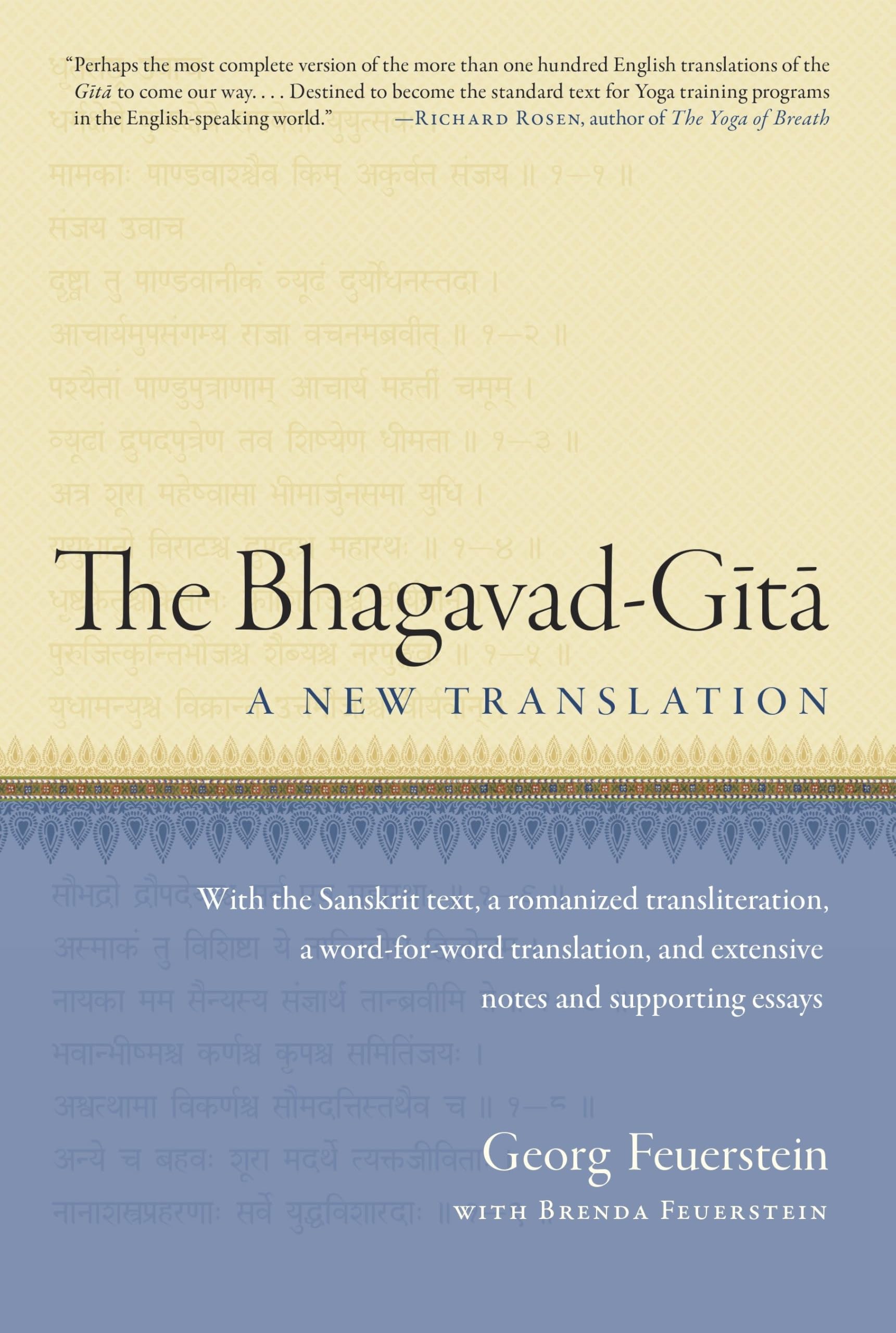
The Bhagavad-Gita: A New Translation
Product ID: 8449615
Desertcart purchases this item on your behalf and handles shipping, customs, and support to Tunisia.
A fresh English translation laid out facing the original Sanskrit for easy reference and accompanied by a wealth of essential ancillary materials that make this book a complete course on the Bhagavad-Gītā in a single volume. This translation stands out from the many others first of all in its careful faithfulness to the original language, but also for the extensive tools for understanding it provides. It is accompanied by detailed explanatory notes, as well as by the entire Sanskrit text on facing pages--both in the original Devanagri alphabet and in a romanized version that allows the reader to approximate the sounds of this work (a pronunciation guide is also provided). Also included is a literal, word-for-word translation for comparison; extensive material on the background, symbolism, and influence of the Gītā ; and an exhaustive glossary of terms. Review: A fresh and scholar translation of the Gita - The central episode of the greatest Oriental epic poem, the Mahabharata, is the Bhagavad-Gita. Gandhi and many scholars have said that the Gita and the Sermon on the Mount are the two most important moral teachings ever produced. Written almost 2400 years ago, this seminal work was the first major book ever translated from Sanskrit into a Western language; Sir Charles Wilkins did the translation into English in 1775. One of the central and paradoxical messages of the Gita is `to act, but without reflecting on the fruits of the action... forgetting desire and seeking detachment.' Some famous intellectuals, including Ralph Waldo Emerson, Henry David Thoreau, William James, Aldous Huxley, Carl Jung, and the director of the Manhattan Project, J. Robert Oppenheimer, found their inspiration in the Gita. The modern American composer, Philip Glass, wrote his opera Satyagraha (1980), based on Ghandi's life, and by using only the Gita texts in Sanskrit, he shows its relevance to modern life. We have hundreds of translations of the Gita; do we need a new one? We have many good English translations. Some are very poetic, such as those by Sir Edwin Arnold (1899), Juan Mascaro (1962), and Barbara Stoler Miller (1986). Others deal with its psychological meaning (Swami Rama, 1985), or with its philosophical and spiritual character, including Eknath Easwaran (1985), and Swami Bhaktivedanta (1983); the last one used to be freely distributed by Hare Krishna monks at airports and subway stations. Georg Feuerstein and his wife Brenda have finally published a long-awaited rendition of the Gita. Feuerstein is one of the greatest yoga scholars today, a philosopher, Sanskrit scholar, historian, and prolific author. His Yoga Tradition (1998), and his translation of Patanjali's Yoga Sutra are seminal works and reflect the serious effort of a dedicated career. This translation "is far more literal than previous renderings ... [and] is based on my earnest effort to capture as much as possible of the spirit of this time-honored work and also to do justice to its language as best as I could, though realizing that my approach of textual and contextual fidelity cannot also at the same time reflect the Gita's melodious quality", says the author. The first part of the book is a good preparation before stepping into the text; it summarizes in 76 pages the historical significance of the Gita, its spiritual and moral implications, and its relevance to deal with modern issues. It also has a good summary of the plot and of the various characters involved. The second part presents the Sanskrit text, its transliteration and the author's translation, with an abundant number of explanatory footnotes. The third part has a word-for-word translation of the 18 chapters that facilitates an easy comparison with other translations, thus constituting an invaluable source for anyone who would like to get a deeper meaning of the text. A selected bibliography, a glossary of select terms in the Gita, and a very comprehensive index are additional assets of this excellent rendition. The Bhagavad-Gita and Patanjali's Yoga Sutra are the two most important philosophical references in the yoga literature and Feuerstein has provided us with splendid analyses and translations of these two masterworks. After reading the new translation, it becomes a joy to come back to any of the poetic renditions, or even, to watch the 15-minute version of the Gita that is included in the six-hour rendition of Peter Brook's Mahabharata, on DVD. It is expected that Shambhala will make soon a paperback edition at a more affordable price. Review: Good translation - I like this translation. It seems very scholarly and thorough. It also seems to take care to be pretty literal, largely refraining from what I call "commentary through mistranslation". Plenty of helpful explanatory notes and things. I would recommend it.
| Best Sellers Rank | #355,770 in Books ( See Top 100 in Books ) #104 in History of Hinduism #226 in Sacred Hindu Writings #683 in Yoga (Books) |
| Customer Reviews | 4.7 out of 5 stars 62 Reviews |
G**S
A fresh and scholar translation of the Gita
The central episode of the greatest Oriental epic poem, the Mahabharata, is the Bhagavad-Gita. Gandhi and many scholars have said that the Gita and the Sermon on the Mount are the two most important moral teachings ever produced. Written almost 2400 years ago, this seminal work was the first major book ever translated from Sanskrit into a Western language; Sir Charles Wilkins did the translation into English in 1775. One of the central and paradoxical messages of the Gita is `to act, but without reflecting on the fruits of the action... forgetting desire and seeking detachment.' Some famous intellectuals, including Ralph Waldo Emerson, Henry David Thoreau, William James, Aldous Huxley, Carl Jung, and the director of the Manhattan Project, J. Robert Oppenheimer, found their inspiration in the Gita. The modern American composer, Philip Glass, wrote his opera Satyagraha (1980), based on Ghandi's life, and by using only the Gita texts in Sanskrit, he shows its relevance to modern life. We have hundreds of translations of the Gita; do we need a new one? We have many good English translations. Some are very poetic, such as those by Sir Edwin Arnold (1899), Juan Mascaro (1962), and Barbara Stoler Miller (1986). Others deal with its psychological meaning (Swami Rama, 1985), or with its philosophical and spiritual character, including Eknath Easwaran (1985), and Swami Bhaktivedanta (1983); the last one used to be freely distributed by Hare Krishna monks at airports and subway stations. Georg Feuerstein and his wife Brenda have finally published a long-awaited rendition of the Gita. Feuerstein is one of the greatest yoga scholars today, a philosopher, Sanskrit scholar, historian, and prolific author. His Yoga Tradition (1998), and his translation of Patanjali's Yoga Sutra are seminal works and reflect the serious effort of a dedicated career. This translation "is far more literal than previous renderings ... [and] is based on my earnest effort to capture as much as possible of the spirit of this time-honored work and also to do justice to its language as best as I could, though realizing that my approach of textual and contextual fidelity cannot also at the same time reflect the Gita's melodious quality", says the author. The first part of the book is a good preparation before stepping into the text; it summarizes in 76 pages the historical significance of the Gita, its spiritual and moral implications, and its relevance to deal with modern issues. It also has a good summary of the plot and of the various characters involved. The second part presents the Sanskrit text, its transliteration and the author's translation, with an abundant number of explanatory footnotes. The third part has a word-for-word translation of the 18 chapters that facilitates an easy comparison with other translations, thus constituting an invaluable source for anyone who would like to get a deeper meaning of the text. A selected bibliography, a glossary of select terms in the Gita, and a very comprehensive index are additional assets of this excellent rendition. The Bhagavad-Gita and Patanjali's Yoga Sutra are the two most important philosophical references in the yoga literature and Feuerstein has provided us with splendid analyses and translations of these two masterworks. After reading the new translation, it becomes a joy to come back to any of the poetic renditions, or even, to watch the 15-minute version of the Gita that is included in the six-hour rendition of Peter Brook's Mahabharata, on DVD. It is expected that Shambhala will make soon a paperback edition at a more affordable price.
A**S
Good translation
I like this translation. It seems very scholarly and thorough. It also seems to take care to be pretty literal, largely refraining from what I call "commentary through mistranslation". Plenty of helpful explanatory notes and things. I would recommend it.
J**E
and a useful word by word translation in a separate section
As you may know, this version of the Bhagavad Gita contains the text in Sanskrit (in Devanagri and transliterated), a translation into English with footnotes, and a useful word by word translation in a separate section. The translation is quite technical and as neutral as it can be, allowing the reader to make his/her own interpretation. In the footnotes we find alternative translations by other authors of the most difficult or controversial passages, as well as explanations for the chosen translation. As a result, it is not as "poetical" as other translations, but it has the advantage of feeling closer to the original text. The first part of the book is a collection of short essays that helps the reader to put the work in context. They are all didactic and entertaining. It contains a chronology of the main events in the ancient history of India, a summary of the story of the Mahabharata, a description of the characters that appear in the Gita, and several other interesting issues, like the place of the Gita in Hinduism. These essays are, again, as neutral as they can be: although the author doesn't hide his own opinions here and there, he does not express them in an intrusive way, and they are easy to separate from the facts. My only complain about this book is the quality of the paper, which is not very good, and the flimsy cover. But the content itself is really worth the price. Although I do not totally agree with Feuerstein in some issues, this is the best version of the Gita that I have read so far, because of its intellectual honesty and clarity. If you want to study the Bhagavad Gita for whatever reason, or even if you have never read it and just want an introduction, getting this book is an excellent idea.
R**N
An admirable new edition
There is a lot to like about this new translation of the Bhagavad Gita. As a reader with not a bit of Sanskrit I can't really judge the quality of the translation. But it is apparent that Feuerstein is emphasizing verbal accuracy. And I find that any translation with a parallel original text acts as a spur to pick up at least a few elements of the original. In comparing this translation with those I already owned, of Edwin Arnold and Barbara Stoler Miller, I can appreciate the value of these different approaches. Arnold is quite consciously poetic and "Oriental." Miller displays a freer, more contemporary American style. In, for example, omitting almost all of the epithets for Krishna and Arjuna, Miller makes the text run swifter and smoother, but loses much of the richness (the same thing happens with translations of Homer). With substantial introductory material, and frequent footnoting, this is a version that encourages close and careful reading. Though a Westerner, Feuerstein appears to rely as much on Indian as Western scholarship. And though he does have a particular approach as an exponent of Yoga, I don't perceive that this edition is excessively "sectarian."
C**P
Best of 5 Gita translations i have but not perfect
There are huge biases in many Gita translations, this author knows his stuff and does note several differing sources for various lines. In a few cases I think he had decent teachers but not a great Advaita swami to leave that grand impression that makes one see some things clearer than before. Ashtavakra Gita is preferrable to Bhagavad Gita for me as the Bhagavad Gita always has the possible taint that it might be made with the sense of making people's lives better and yet keeping them in their place. It really does denounce race and social status mixing unless you mess with the translation. I prefer an honest spiritual perspective that does not need to make my circumstances better, or make me willing to work hard for a nice house.
R**H
Necessary. If you have any interest in the Gita ...
Necessary. If you have any interest in the Gita at all beyond simple curiosity Feuerstein's seminal work on the subject is simply a necessary part of your library. The essays in the first section place the Gita in context historically and conceptually outside of the framework of what has become the orthodox academic views. Feuerstein was a yogin before he was an academic and his worldview reflects that. Further, he can back it up as the depth of his study was unparalleled. His translation itself is designed to accurately convey the teaching of the Gita, not the beauty of it's poetry. It becomes an important reference for considering any other translations or interpretations as your study of the text deepens. Finally, the last section in which the Sanskrit, the English transliteration, and the definition of each word is laid out next to each other provides a source for the reader to begin to use his or her own judgement when questions arise as to what the text means and how it was interpreted. It is a complete work, this book.
R**D
My favorite Gita!
I have a number of Gita translations, but this is now far and away my absolute favorite! Great translation, easy to read, well organized, and copious notes at the bottom of each page. I wish I could buy this for my Kindle also. Hint hint to publisher......
X**C
Simply the best
This translation along with the Oxford translation are simply the best. I highly recommend.
S**V
Exactly what I was looking for
This is exactly what i was looking for. The Gita sanskrit verses with english transliteration. It then has the literal english translation with supportive text BUT the supportive text doesn't appear to direct your understanding. At a glance it looks like this copy allows you to interpret the gita in your own way which is exactly what I wanted. I haven't read it all but am delighted to finally find a copy which translates the Gita without the writers spin/view on the meaning
B**S
Gift
Recipient was delighted to receive this.
R**N
Beautiful
Beautiful helpful version with everything you need to know. Sanskrit, transliteration, english translation, historical info all there
Trustpilot
2 weeks ago
1 month ago