
DOWNLOAD THE APP


Customer Services
Copyright © 2025 Desertcart Holdings Limited
DOWNLOAD THE APP
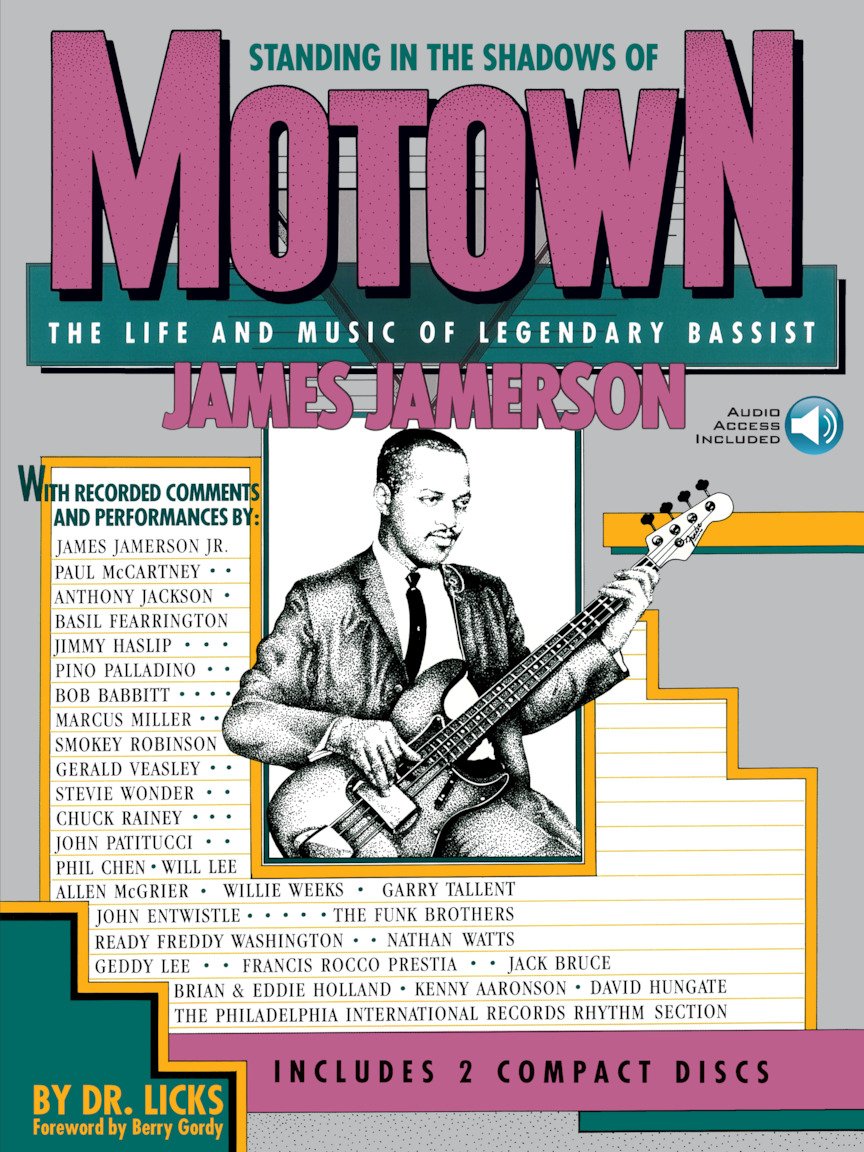
🎶 Unlock the bass secrets behind Motown’s timeless hits—feel the groove, join the legacy!
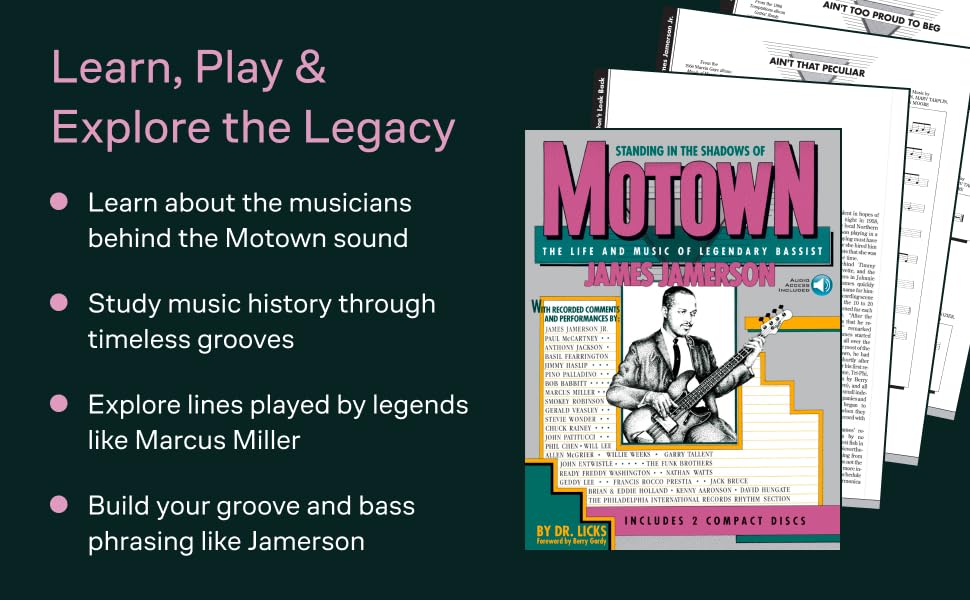
Standing in the Shadows of Motown is a 212-page bass guitar songbook featuring 49 transcriptions of James Jamerson’s iconic bass lines, accompanied by online audio with isolated bass tracks. This comprehensive resource blends biography, historical context, and expert analysis with performances by renowned bassists, offering an advanced yet immersive learning tool for aspiring and seasoned bass players eager to master the classic Motown sound.


| Best Sellers Rank | #82,058 in Books ( See Top 100 in Books ) #2 in R&B & Soul #7 in Bass Guitar Songbooks #115 in Guitars (Books) |
| Customer Reviews | 4.7 out of 5 stars 619 Reviews |
R**S
A good book about a great bassist
This book and CD combination examines the music of James Jamerson, the studio bassist on most of the early Motown hits. Until rather recently, Jamerson was unknown to the general public and not widely known to musicians. Nonetheless, his playing was very influential and many bassists today consider his playing the gold standard of bass guitar in popular music. This book is valuable as a reference for the history of Motown, but it is primarily a teaching tool. It is organized into three parts. The first 78 pages give a biography of Jamerson and put his work into historical context. Part two (17 pages) is a compilation of data: descriptions of bass equipment, recording facilities, accompanists, and discography. Also included in this section is a four page "Appreciation of Style" by Anthony Jackson that attempts to analyze the musical elements that made Jamerson unique. Part three contains 90 pages of transcriptions of Jamerson bass lines and accompanying text. The transcriptions go with the CDs described below. The CDs and transcriptions are the heart of the set. The CDs feature Motown tunes with the bass lines played by over two dozen "all-star" bassists (e.g Marcus Miller, Jack Bruce, John Entwistle). Bass is on the left channel with instrumental accompaniment on the right. The bass lines are transcribed by the author and the transcriptions are accompanied by short bios of the artists who play the lines. The tracks on the CDs are interspersed with short interviews of people who knew Jamerson. The artists reportedly donated their services as a tribute to Jamerson and the bass lines and accompaniment were recorded in a variety of circumstances. Many tracks are recorded in home studios. The quality varies, but all tracks are well played and all are useful teaching tools. I thought the variation of sounds would be a drawback, but it is a very interesting part of the project. The best Precision Bass tones are not necessarily from the artists you would expect. (Not everyone tries to duplicate Jamerson's tone. Geddy Lee was approached backstage at a concert and contributed "Get Ready" on either a Steinberger or a Rickenbacker. Lots of fun.) The level of the transcriptions is somewhat advanced. Transcriptions are given in traditional bass staff (no tab) and the rhythms will give your reading skills a workout. There are very few specific comments about fingering, right-hand technique, or damping. Yet the range of difficulty is from dead simple (beautifully rendered) line to lines that will challenge the most advanced player. (The challenge is rhythm and feel not lots of note or big stretches.) Beginning to intermediate players can use this book, but will benefit greatly by using it with the help of a good teacher. One can quibble with the historical overview. It is quite readable, but doesn't dig deeply into any of the tough issues it raises (e.g. Jamerson's drinking and emotional stability, Berry Gordy's business practices). Since the focus is on the music, some of this reticence is laudable. However, one important musical controversy that the author fails to pursue is the question of the true credit for recorded bass lines in the era when Motown was moving from Detroit to LA. (Many tracks were demoed by LA studio bassists and then cut by Jamerson as well. There is still debate as to which track made it to the final recording. The question is acknowledged, but no new information is brought forth.) Another musical deficit is that there is very little about the interplay between Jamerson and other members of the rhythm section. (This is in contrast to the author's better-written (if slightly less important) book on the James Brown rhythm sections.) Even with those minor issues considers, this is an extremely valuable book. It is clearly a labor of love and will be an extremely valuable learning tool for any bassist with the fundamental skills (or support) necessary to ap
G**N
Excellent source for Motown enthusiast / aspiring bassist
I feel that I am a mediocre bass player, but this product helped me play bass with more feel. It is an excellent source of info about motown in general and includes many stories about James Jamerson (the baddest bass player to play a fender bass). There are a ton of bassists (including james jamerson jr.) offering their insights into James' bass playing and their rendition of many of his best bass lines on cd. The bass lines are played note for note so you can really learn many of the old motown songs just the way jamerson played it (if you can keep up)... The bass lines are on one channel and the music is on the other, making it easy to turn off a channel and either play with the music or listen to the bass line only. I always used to wonder who was playing those cool bass lines for Motown way back in the day, there were never any credits for musicians on the albums back then. I found out it was James Jamerson in 1997 (about 20 years later). This is an excellent product and I was really pleased with the way it was set up. It has changed the way I play. I highly recommend this to the aspiring bass player and Motown enthusiast.
M**I
Don't give singers all the credit!
I've always been a fan of Motown but of the singers, now I'm starting to realize I shouldn't give the singers all the credit, it was the producers, songwriters, and musicians who made the artists become hits. If it wasn't for the unique, special Funk Brothers who knows if the Motown artists would have become as successful as they did. It doesn't matter how good of a singer a singer is, if the music ain't right, the singer ain't gonna sound good. Its that something special about the Motown Sound that sparks something in our minds, hearts, and souls, the music complimented the singers excellently. James Jamerson was just a handsome, wonderful, real, interesting, talented person. Its sad he had to get recognition after he passed on. It seems the only way to become a legend is to die first then people appreciate you more, well this book taught me to love and praise people while their alive that's what keeps them going. All James wanted in his last days was recognition and to know he did make a difference in the world of music. This book taught me to appreciate the musicians, songwriters, and producers, the people behind the scenes, who made it possible for the music to become timeless, sometimes we give the singers too much credit. It was interesting for me to read most of the Funk Brothers didn't even like Rock N Roll or Soul music, they were really jazz fans and wanted to play jazz, so it shows how gifted they were to still play soul music effectively even though it wasn't their cup of tea. Another reason why Motown sound is so appealing and fresh is because the Funk Brothers laced different genres of music into the soul music and tried new things with the music creating the Motown Sound, a sound in its own class.
K**3
Excellent
In addition to providing a comprehensive biography of the legendary bass player, this book is chock full of great photos. A must for anyone interested in the history of the Motown record company.
P**R
Great lesson
Great learning tool. Many good tunes and a good way to understand Jameson style
M**M
The long shadow of James Jamerson
All those years ago when I was taking lesson on how to play bass and read the bass clef, my tutor got me to buy a book "Rock Riffs for Bass" which covered a wide variety of bassists and bass styles. Amongst the most influential bass players mentioned in this book was James Jamerson, The Mowtown Sound. I had never heard of him but I had heard many of the songs he recorded coming out of the radio but at the time I was more into players like John Entwistle, Jack Bruce, John Paul Jones etc, so his significance passed me by. Many, many years later I saw the movie "Standing in the Shadows of Mowtown" and again James was one of the featured musicians, I took more notice but never really investigated further. Just recently I was listening to some of Marvin Gaye's music and while focussing on the bass sound it prompted me to do a search on the web to read a bit more about this bass player. I found this book and based on the reviews I read, decided to buy it. Even though it was written in the late 80's the telling of his life story and transcription of his playing remains timeless. It could easily be a textbook for budding musicians and the Cd's included are an added bonus. James was an inovator and as it always seems with genius, recognition of their contribution happens after their flame burns out.
C**L
Almost any student of electric bass will want to peruse ...
Almost any student of electric bass will want to peruse this book. Motown, soul, funk, R&B, rock & roll, pop-- James Jamerson's influence on so much music is pervasive, and Dr. Licks and the all-star list of contributors show you how by sharing Jamerson's story and getting into the nitty gritty of his music and instrumentation. The first section of the book tells the intertwined story of early Motown and Jamerson and is loaded with fascinating tidbits and micro-stories, many told in the words of folks who were there in Hitsville, USA. You can flip to any page and gain a unique insight that conveys just how special Motown was in the sixties and early seventies-- even Motown could not re-create the Motown sound made immortal during those years. A later section features dozens of transcriptions put together by Dr. Licks and played by famous bass players on the included audio CD's. They do a more accurate job of showing how Jamerson created some of his most famous bass lines than any free bass tab you can find on the internet. However, you'll realize that he probably would have laughed at the idea of people playing his music note-for-note. This is because he and the rest of the rhythm section of Motown's Funk Brothers were given an incredible amount of freedom in the way they performed during recording sessions, especially Jamerson, whose playing style relied heavily on feeling and groove. Bass players could certainly borrow and be inspired by certain elements of his style, but for most people, the transcriptions simply offer a raw glimpse into his off-the-walls musical mind (spoiler alert: it involves lots of syncopation).
A**R
What every working musician should know regardless of your genre
Well written, both in storytelling and music charts. I’m a classically trained pianist and bassist, and a working musician. This is a great book no matter what your genre is but from a bass player’s point of view, it’s so interesting to see how Jamerson incorporates his musical and rhythmic lines together. He really knew how to ‘move’ the music he was playing. His jazz influence comes through. His classical training comes through. I liked reading the stories in the back from Bass players that came after him, and how his influence seeped into their musical styles as well. I know it did for mine.
Trustpilot
2 days ago
2 weeks ago