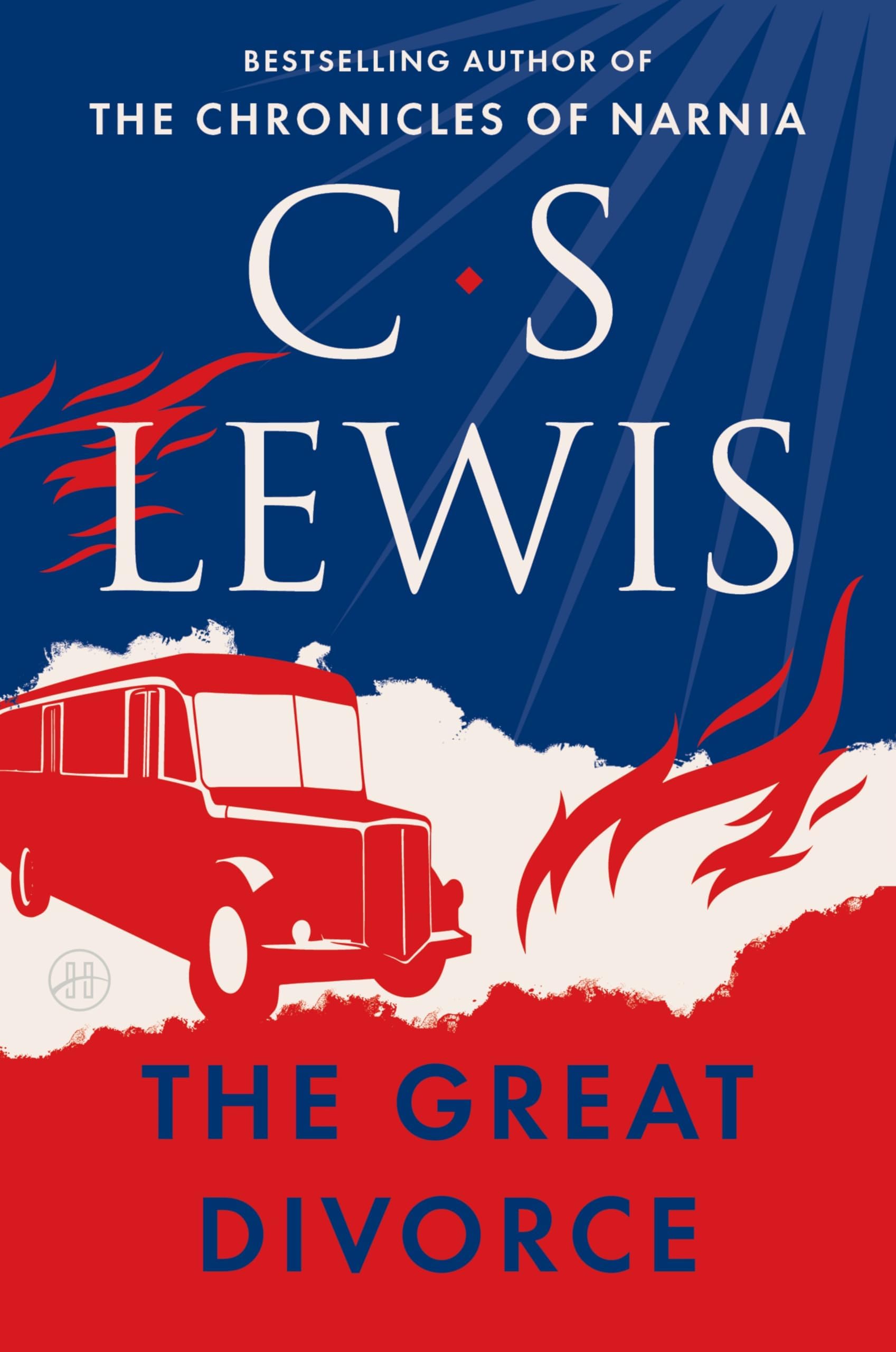
The Great Divorce
Product ID: 290345
Buy anything from 5,000+ international stores. One checkout price. No surprise fees. Join 2M+ shoppers on Desertcart.
Desertcart purchases this item on your behalf and handles shipping, customs, and support to Tunisia.
The Timeless Novel About a Bus Ride from Hell to Heaven In The Great Divorce, C.S. Lewis again employs his formidable talent for fable and allegory. The writer finds himself in Hell boarding a bus bound for Heaven. The amazing opportunity is that anyone who wants to stay in Heaven, can. This is a starting point for an extraordinary meditation upon good and evil, grace and judgment. Lewis’s revolutionary idea is the discovery that the gates of Hell are locked from the inside. Using his extraordinary descriptive powers, Lewis’s The Great Divorce will change the way we think about good and evil. Review: This book is engaging as it stretches your mind and imagination - My son introduced me to this book. I loved it because it made me think. I would read it again and plan to gift copies to others. Review: interesting allegory! - Very good! Certainly an interesting allegory and brings out the unique nature of CS Lewis’s writing style. Our priest let us through a study of this book this year during lent.



| Best Sellers Rank | #893 in Books ( See Top 100 in Books ) #4 in Christian Self Help #6 in Inspirational Spirituality (Books) #27 in Christian Spiritual Growth (Books) |
| Customer Reviews | 4.6 out of 5 stars 11,728 Reviews |
J**N
This book is engaging as it stretches your mind and imagination
My son introduced me to this book. I loved it because it made me think. I would read it again and plan to gift copies to others.
A**R
interesting allegory!
Very good! Certainly an interesting allegory and brings out the unique nature of CS Lewis’s writing style. Our priest let us through a study of this book this year during lent.
N**P
Favorite fiction book with a Christian theme
The Great Divorce excels at story telling in a way that captures your heart. It's a fictional story, but C.S. Lewis weaves in different theological ideas in story form. Yes, he does admit that everything in the story if speculation but it's hard not to believe that his theology influenced his writing of this book. The beginning starts off a little slow but there are multiple points in the book that are really enchanting, more than at the story level, but at the heart level as well. You begin to see yourself in some of these characters and their decision-making. More importantly, he does a great job of imagining what life in the next world might be like. Of course, that's speculation, but if he's able to enchant your heart with his own thoughts, how much more will it actually be!
B**A
interesting concepts
His description of heaven and hell are very different but are an interesting take on the subject. Some of the descriptions of characters were hard to follow at times.
F**S
The Divine Comedy meets the Screwtape Letters
This is a very curious book. When I first picked it up, I had no clue that it would be an excursion into death; more specifically, into what might happen to the soul after death; and even more specifically, into how souls might achieve Heaven or choose Hell. For starters, The Great Divorce is not a dry, philosophical book. It is a cleverly written first-person narrative that begins on a bus ride from a dreary town and ends in a lush garden full of creatures both magnificent and wretched. For the passengers on the bus, the garden is so unbearably real and solid that they can hardly stand it at first. Most will find an excuse to get back on the bus. But a scant few will be persuaded to cast off their attachments to life in the town and head off toward the mountains where an inexpressible joy awaits them. It is against this backdrop that Lewis sets up the core of the work--a sequence of vignettes that perceptively describe some of the major reasons why people turn away from the salvation offered by God through His Son, Jesus. These are, in the main, so beautifully drawn and so frighteningly true to life that every reader must find himself in the crosshairs in one or another of them. Lewis is a brilliant writer and thus this book is littered with wonderful little aphorisms. Two of my favorite are: "There are only two kinds of people in the end: those who say to God, 'Thy will be done,' and those to whom God says in the end, 'Thy will be done.' All that are in Hell, choose it. Without that self-choice there could be no Hell." "Every young man or boy that met her [an anonymous saint] became her son -- even if it was only the boy that brought meat to her back door....There are those that steal other people's children. But her motherhood was of a different kind. Those on whom it fell went back to their natural parents loving them more." In short, The Great Divorce is brilliant and enlightening. Great food for thought for those traveling through the earthly existence.
L**N
Very Thought Provoking
Lewis is a very powerful writing. That is a known fact. That is why he is so frequently read, quoted, patterned after, and studied. I have listened to many of his books and read Chronicles of Narnia several times. So when this book came up on my book clubs list I thought I will try reading but it its to difficult I can always go to the audio book. Well I nit only read this book. I marked several passages and plan to read it again
A**R
I wish I’d read this book when I was much younger.
This is the most interesting book I’ve ever read. And I read a lot.
C**P
questions big and small
Through these vignettes we consider the foibles and issues that create problems in our lives and prevent us from truly living in love. But he also suggests much larger ideas about heaven hell, purgatory, choice and predestination. And how it’s all ultimately unknowable.
E**S
great read
Fantastic read! Like I was reading a Haruki Murakami.
C**E
on of my top 5
I love this book. So thought provoking. CS Lewis has such an incredible imagination. His story highlights how seemingly loving behaviours are not and how we hang onto things in this world that have no value with the eyes of heaven. I highly recommend the book.
N**Y
Bonne taille et poids, très bon contenu.
On a commandé 2 par hasard, mais on a finalement vraiment resté avec les deux puis le livre et très bonne, donc on a offert une pour nôtres amis. Livre d’une bonne taille et poids, facile a transporter et lire.
M**L
One of C S Lewis' Greatest Works
Do not underestimate this book, just because it does not deal with Narnia - it is one of his most beautiful and thought-provoking books. I have a paper copy and have read it many times, and have now moved to the Kindle edition, which is much easier to read, physically speaking. There are three small textual errors in the Kindle version of the book. The first is as follows: On page 45 the text reads: The noise, though gigantic, was like giants' laugh-ten like the revelry of a whole college of giants together ... It should read: The noise, though gigantic, was like giants' laughter: like the revelry of a whole college of giants together ... On page 62, the text reads: .. the whole wood trembled and dwindled at the sound. It should read .. the whole wood trembled and dindled at the sound. On page 81, the text reads: ..only to Spit and gibber out in one ecstasy of hatred .. It should read: .. only to spit and gibber out in one ecstasy of hatred .. It is a great book, and other than these three errors, the text is just great, conveying all of Lewis' imaginative greatness. I cannot over-emphasise just how amazing this book is; I personally re-read it about once every couple of months and am always thinking about the truths conveyed in it.
A**O
Absolutamente incrível!
Eu já tinha escutado podcasts sobre essa obra e comecei a lê-la com a expectativa lá em cima, e realmente eu não me decepcionei nem um pouco! É incrível como C. S. Lewis consegue fazer você refletir na sua própria vida, nos seus próprios vícios e hábitos que só te distraem do verdadeiro centro cuja nossa vida deve ser centrada – o Deus verdadeiro – e tudo isso em tão poucas páginas. Esse livro mudou minha vida, de verdade. Não tenho palavras pra descrever o quanto eu recomendo ele pra todos.
Trustpilot
1 month ago
2 weeks ago