We remain fully operational. Our teams are working around the clock to ensure your deliveries continue safely.

DOWNLOAD THE APP


Customer Services
Copyright © 2025 Desertcart Holdings Limited
DOWNLOAD THE APP
Full description not available
C**R
'Science replaced God. It created a vacancy: the office of the supreme legislator-manager, was horrifyingly empty'
“Together with the new unheard-of potency of man-made technology came the impotence of self-limitations men imposed through the millennia upon their own mastery over nature and over each other: the notorious disenchantment of the world or, as Nietzsche put it, ‘death of God’.’’ (217)Technology killed god? What happened?“God meant, first and foremost, a limit to human potential: a constraint, imposed by what man may do over what man could do and dare do. The assumed omnipotence of God drew a borderline over what man was allowed to do and to dare. Commandments limited the freedom of humans as individuals; but they also set limits to what humans together, as a society, could legislate; they presented the human capacity to legislate and manipulate the world’s principles as being inherently limited.’’Human ‘science’ has unlimited ability! Why listen to God?“Modern science, which displaced and replaced God, removed that obstacle. It also created a vacancy: the office of the supreme legislator-cum-manager, of the designer and administrator of the world order, was now horrifyingly empty. It had to be filled, or else … God was dethroned, but the throne was still in one place.''"The emptiness of the throne was throughout the modern era a standing and tempting invitation to visionaries and adventurers. The dream of an all-embracing order and harmony remained as vivid as ever, and it seemed now closer than ever, more than ever within human reach. It was now up to the mortal earthlings to bring it about and to secure its ascendancy.’’God is not dead! Human society has just replaced him!“The world turned into man’s garden but only the vigilance of the gardener may prevent it from descending into the chaos of wilderness. It was now up to man and man alone to see to it that rivers flow in the right direction and that rain forests do not occupy the field were groundnuts should grow. It was now up to man and man alone to make sure that the strangers do not obscure the transparency of legislated order, that social harmony is not spoiled by obstreperous classes, that the togetherness of folk is not tainted by alien races. The classless society, the race-pure society, the Great Society were now the task of man –an urgent task, a life-and-death matter, a duty. The clarity of the world and human vocation, once guaranteed by God and now lost, had to be fast restored, this time by human acumen and on human responsibility (or is it irresponsibility?) alone.’’ (217)This seems to me the key theme. Human society (human experts, human Reason) can do anything, solve any problem, fix any failure; this expectation supports Hitlerism, Stalinism, etc.. Modernity’s belief in this ability. . .this power. . .this potential - makes our world profoundly unique.1 Introduction: Sociology after the HolocaustThe Holocaust as the test of modernityThe meaning of the civilizing processSocial production of moral indifferenceSocial production of moral invisibilityMoral consequences of the civilizing process2 Modernity, Racism, Extermination ISome peculiarities of Jewish estrangementJewish incongruity from Christendom to modernityAstride the barricadesThe prismatic groupModern dimensions of incongruityThe non-national nationThe modernity of racism3 Modernity, Racism, Extermination IIFrom heterophobia to racismRacism as a form of social engineeringFrom repellence to exterminationLooking ahead4 The Uniqueness and Normality of the HolocaustThe problem Genocide extraordinaryPeculiarity of modern genocideEffects of the hierarchical and functional division of labourDehumanization of bureaucratic objectsThe role of bureaucracy in the HolocaustBankruptcy of modern safeguards5 Soliciting the Co-operation of the Victims‘Sealing off’ the victimsThe ‘save what you can’ gameIndividual rationality in the service of collective destructionRationality of self-preservation6 The Ethics of Obedience (Reading Milgram)Inhumanity as a function of social distanceComplicity after one’s own actTechnology moralized Free-floating responsibilityPluralism of power and power of conscienceThe social nature of evil7 Towards a Sociological Theory of MoralitySociety as a factory of moralityThe challenge of the HolocaustPre-societal sources of moralitySocial proximity and moral responsibilitySocial suppression of moral responsibilitySocial production of distance8 Afterthought: Rationality and ShameSocial Manipulation of Morality“In the years leading to the Final Solution the most trusted of the safeguards had been put to a test. They all failed –one by one, and all together. Perhaps the most spectacular was the failure of science –as a body of ideas, and as a network of institutions of enlightenment and training.’’ (107)Science failed! Why?“The deadly potential of the most revered principles and accomplishments of modern science has been exposed. The emancipation of reason from emotions, of rationality from normative pressures, of effectiveness from ethics have been the battle-cries of science since its inception. Once implemented, however, they made science, and the formidable technological applications it spawned, into docile instruments in the hands of unscrupulous power. The dark and ignoble role which science played in the perpetuation of the Holocaust was both direct and indirect. Indirectly (though centrally to its general social function), science cleared the way to genocide through sapping the authority, and questioning the binding force, of all normative thinking, particularly that of religion and ethics.’’ (107)Removing moral thinking ‘of religion and ethics’. Was not this a key sign of progress?“Science looks back at its history as the long and victorious struggle of reason over superstition and irrationality. In as far as religion and ethics could not rationally legitimize the demands they made on human behaviour, they stood condemned and found their authority denied. As values and norms had been proclaimed immanently and irreparably subjective, instrumentality was left as the only field where the search for excellence was feasible. Science wanted to be value-free and took pride in being such. By institutional pressure and by ridicule, it silenced the preachers of morality. In the process, it made itself morally blind and speechless. It dismantled all the barriers that could stop it from co-operating, with enthusiasm and abandon, in designing the most effective and rapid methods of mass sterilization or mass killing; or from conceiving of the concentration camps’ slavery as a unique and wonderful opportunity to conduct medical research for the advancement of scholarship and –of course –of mankind.’’ (107)What about academics?“At best, the cult of rationality, institutionalized as modern science, proved impotent to prevent the state from turning into organized crime; at worst, it proved instrumental in bringing the transformation about. Its rivals, however, did not earn a higher score either. In their silence German academics had plenty of companions. Most conspicuously, they were joined by the Churches –all of them.’’ (108)Professors and clergymen? All?“Silence in the face of the organized inhumanity was the only item on which the Churches, so often at loggerheads, found themselves in agreement. None of them attempted to reclaim its flouted authority. None of the Churches (as distinct from single, and mostly isolated churchmen) acknowledged its responsibility for deeds perpetrated in a country it claimed as its domain, and by people in its pastoral charge. (Hitler never left the Catholic Church; neither was he excommunicated.) None upheld its right to pass moral judgements on its flock and impose penitence on the wayward.’’ (108)Well. . .Jehovah’s Witnesses (Bible students) did resist as an organized religion. They are proud to proclaim their neutrality (refused to Hiel Hitler) and have no shame or guilt from that terrible time. They were willing martyrs, not racial victims.This work is a searing indictment of the modern scientific, rational, national system. Bauman is writing as a warning against pride. The misuse of authority, the mistrust in reason, the misplaced confidence in political power, resonates throughout.The holocaust can reoccur.Who will be the victim?Writing is smooth without becoming banal. Erudite although avoiding obscurity.Great!No index. No photographs.(See also: "The Origins of Modern Science'' by Sir Herbert Butterfield. Famous insight into the impact of science.)
R**R
good read
710s philosophy
J**R
Original, in-depth analysis of dangers of the modern worldview
This book is a very well-written, in-depth anaylsis of how the modern, "civilized" mindset enabled normal, everyday Germans (businessmen, professors, soldiers, journalists -- just like your average U.S. citizens) to either actively participate or stand by and do nothing while the leaders of their nation murdered millions of people (the vast majority of whom -- 14 million out of 20 million -- were political opponents, not Jews -- 6 out of 20 million).As the U.S. government is currently murdering millions of people over in the Middle East, everyday Americans are standing around -- either supporting it or doing nothing. For instance 2.5 million people died in the U.S. invasion of Vietnam, tens of thousands of people still die each year in Laos from all of the leftover cluster bombs dropped there by the U.S. (look up "laos plain of jars"), and over 2 million people (500,000 of whom are children) have died in Iraq since the first Persian Gulf War as a result of economic sanctions and U.S. aerial strikes (look up "madeline albright iraq sanctions")--- this is just slightly under the number of Jews that the Nazi regime killed, and it's only three of the U.S.'s dozens of wars that took place during the 20th century.This is the topic of this book -- what causes everyone to stand around and justify large scale, state sanctioned murder? Is it cowardice, cruelty, or something else?
M**S
A highly intelligent discussion
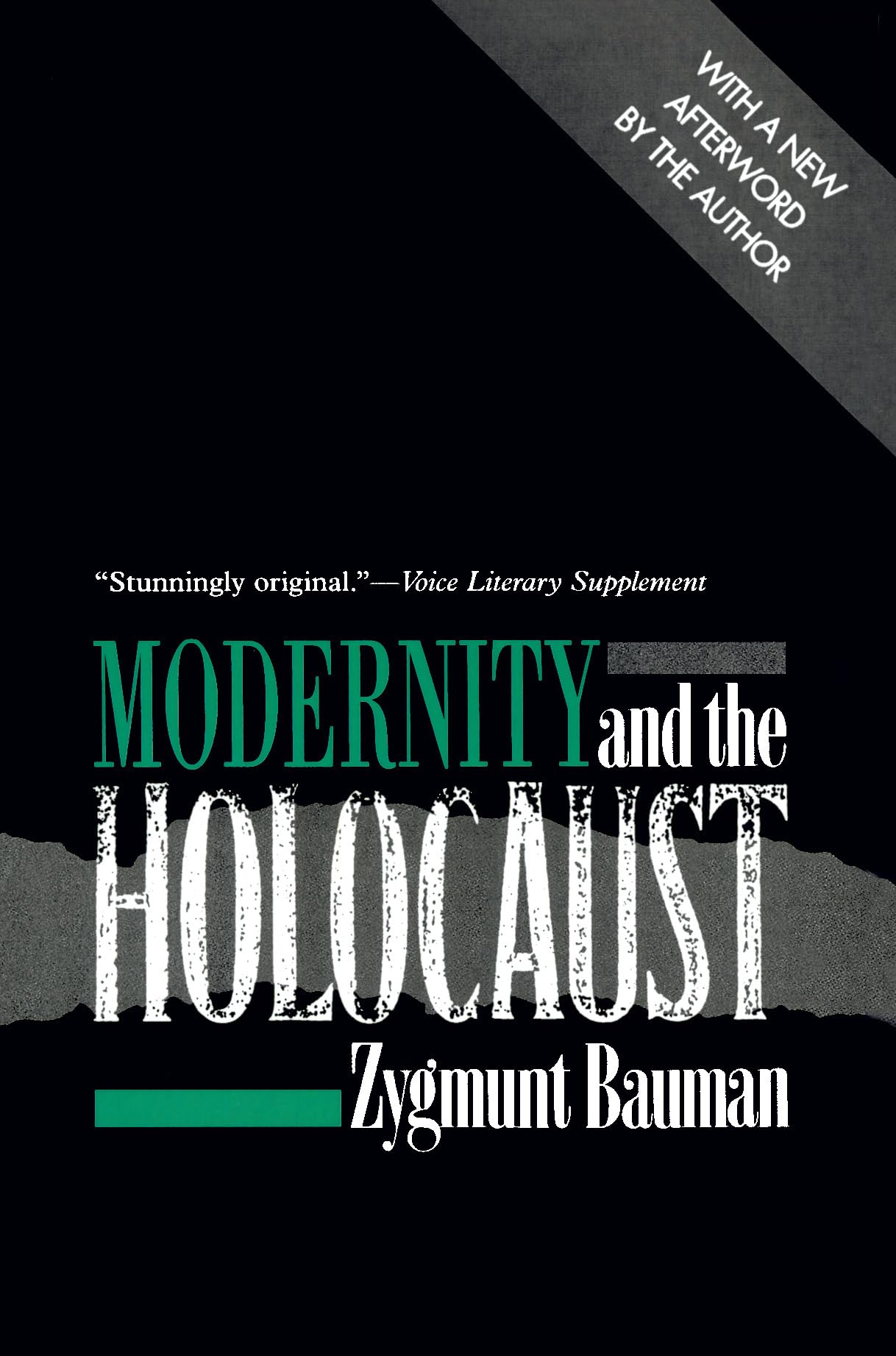
Zygmunt Bauman, a leading sociologist who has done a great deal of seminal work on modernity (in the perception of someone like me who is not a sociologist), turns his attention to the Holocaust of European Jewry in this book under the inspiration of his wife, who lived through it, survived it and has chronicled her experiences. Bauman was born in Poland, an epicentre of the Nazi "final solution of the Jewish problem", though he managed to flee to the Soviet Union and spent the war serving as an officer of the Red Army.In contrast to Daniel Goldhagen's analysis in Hitler's Willing Executioners: Ordinary Germans and the Holocaust, which sees a long and deeply entrenched tradition of viciously eliminationist anti-Semitism, among ordinary Germans as a sine qua non for the Holocaust, Bauman denies flatly that ordinary Germans were viciously anti-Semitic and that deep-rooted atavistic instincts made the Holocaust possible. On his account, rather than being the expression of primitive instincts, what made the Holocaust possible was modernity, represented by an efficient and rational managerial bureaucracy, nested in the context of a totalitarian State.Bauman's analysis is intelligent and demanding. The book does not make for easy reading, either emotionally or intellectually, but it is well worth the effort it takes to work through it. It should be of interest to anyone concerned with the Holocaust, with the history and dynamics of genocide and attempted genocide in Armenia early in the previous century, in Kampuchea, and in Rwanda, inter alia, and about modernity, bureaucracy, and ethics, whether the readers agree with Bauman's compellingly-argued thesis or not.
Trustpilot
2 days ago
1 month ago