
DOWNLOAD THE APP


Customer Services
Copyright © 2025 Desertcart Holdings Limited
DOWNLOAD THE APP
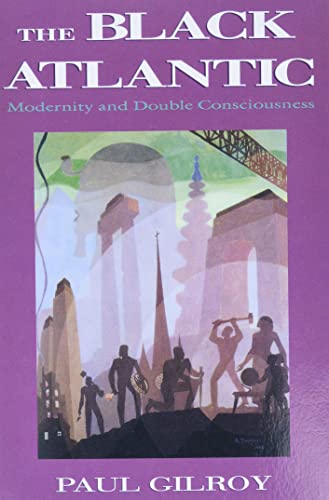
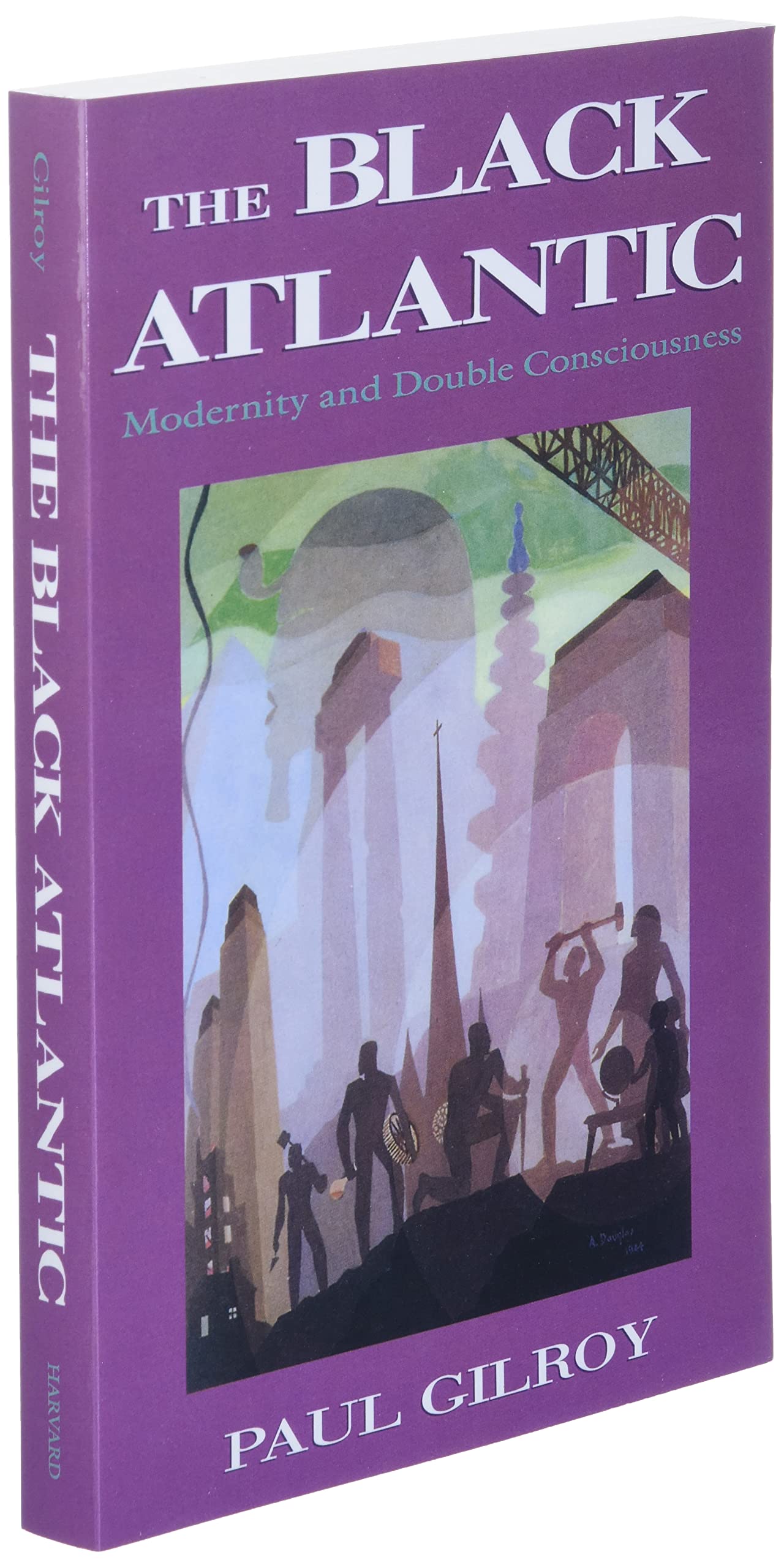
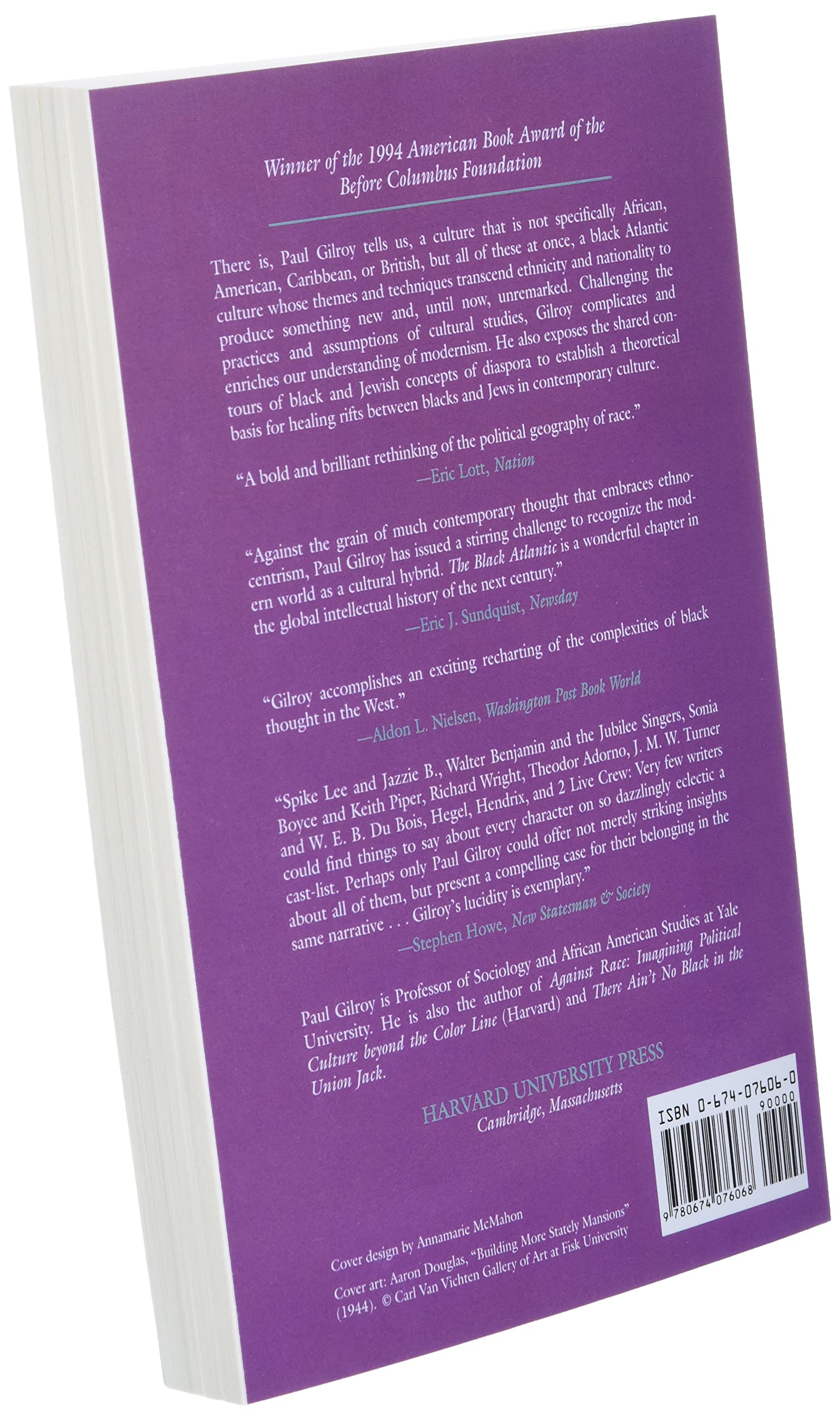
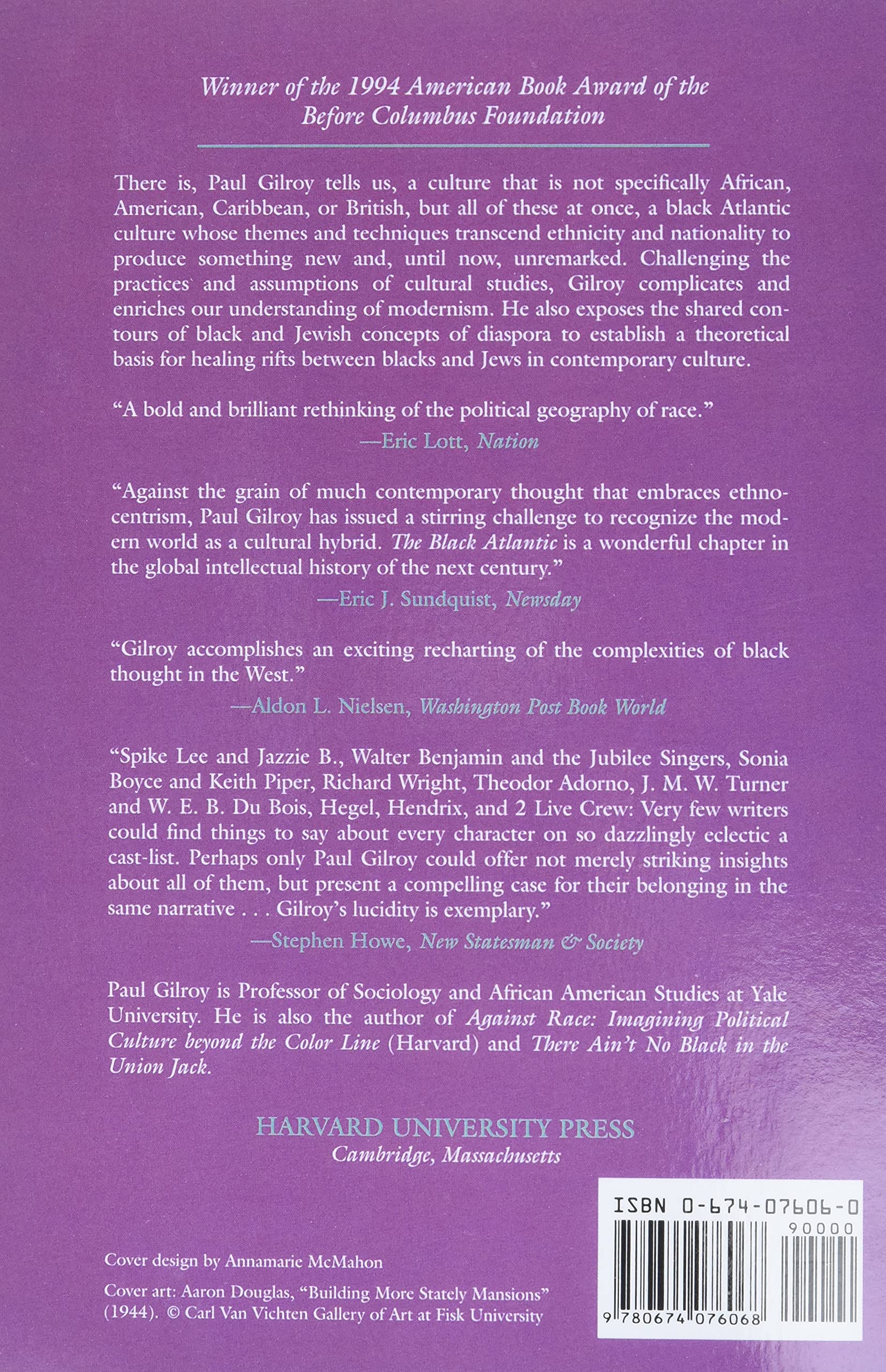

desertcart.com: The Black Atlantic: Modernity and Double-Consciousness: 9780674076068: Gilroy, Paul: Books Review: This book turns historical methodology upside down and introduces transnational ... - This book turns historical methodology upside down and introduces transnational methodology, among other things. A must-read for all new historians learning methodology. Review: Excellent seller - As described and shipped rapidly.
| ASIN | 0674076060 |
| Best Sellers Rank | #88,209 in Books ( See Top 100 in Books ) #17 in Black & African American Literary Criticism (Books) #310 in Black & African American Biographies #324 in African American Demographic Studies (Books) |
| Customer Reviews | 4.7 4.7 out of 5 stars (124) |
| Dimensions | 6.12 x 0.8 x 9.25 inches |
| Edition | Reissue |
| ISBN-10 | 9780674076068 |
| ISBN-13 | 978-0674076068 |
| Item Weight | 13.6 ounces |
| Language | English |
| Print length | 280 pages |
| Publication date | March 8, 1993 |
| Publisher | Harvard University Press |
G**R
This book turns historical methodology upside down and introduces transnational ...
This book turns historical methodology upside down and introduces transnational methodology, among other things. A must-read for all new historians learning methodology.
H**R
Excellent seller
As described and shipped rapidly.
U**R
Five Stars
As advertised.
U**R
A New Continent “in between”
The turn from class politics to identity politics and from „Western Marxism” to post-Structuralist deconstruction in the 1980s appeared to me as a de-politicization of the intellectual discourse and probably also as an effect of the historical defeat of the Left against Neoliberal “There is no Alternative” ideology. Of course there were the exceptional works of Judith Butler, which demonstrated the powder keg implied in deconstruction. But as Literature Theory and Cultural Studies are concerned I saw (and still do) their development from the 1970s to the 1990s rather as a descent into academic institutionalisation and political irrelevance. Peter Gilroy’s “The Black Atlantic” is one of the books that could perhaps change my mind. Coming from a family of Caribbean immigrants to London, Gilroy is both European and black, a black Englishman. Being a black Englishman is in fact a provocation against modern racism per se. While racist and nationalist discourses describe those identities as mutually exclusive, Gilroy is interested in ambiguities and the space between them and finds a whole new world. Gilroy very much builds on W.E.B. Du Bois’ book “The Souls of Black Folk” (1903) and the theory of a “double consciousness”. Gilroy settles on the image of ships in motion and across the Atlantic, the “Black Atlantic”. Gilroy discovers a new continent “in between”. This is the world of Oluadah Equiano and the black Chartists Cuffay and Wedderburn. Did you know that at the end of the eighteenth century a quarter of the British navy was composed of Africans? Gilroy wants to overcome nationalist approaches and argues cultural historians could take the Atlantic as one single unit of analysis and produce an explicitly transnational and intercultural perspective. The book “The Black Atlantic” deals with the journeys of W.E.B. DuBois and Richard Wright. Gilroy explains that contact with Europe were seminal for both authors. Gilroy uses the concept of “Diaspora” instead of the pan-African discourse. Gilroy was a scholar at the famous Birmingham Centre for Contemporary Cultural Studies. He asks critical questions about the association of Cultural Studies with “Englishness” in the works of Raymond Williams and E.P. Thompson. He strongly advocates breaking away from the idea of a left English nationalism. Gilroy wants to break the dogmatic focus on discrete national dynamics and sharply criticizes the “morbid celebration of England and Englishness” in the works of Raymond Williams. Gilroy deals with the painting “The Slave Ship” by J.M.W. Turner and its owner John Ruskin. He demonstrates the complicity of Williams’ national canon of conservative anti-industrialists with slavery. This is a sharp critique of Williams’ famous book “Culture and Society”. Gilroy likes to talk of the Jamaica migrants in Britain as “black settlers” and uses a notion usually reserved for white English colonists in America for black immigrants in England. He is interested in the hybridity and intermixture of ideas. He shows the important role black slaves played in the development of the English labour movement and the important role of Hegelian philosophy in the work of W.E.D. DuBois. Gilroy discovers a complicity of racialized reason and white supremacist terror. He mentions the racist prejudices of Kant, Voltaire, and Burke. In Gilroy’s account black vernacular culture has become a sort of post-modernism “avant la lettre”. Gilroy develops his arguments with black music as the expression of the unspeakable terrors of slavery. The main chapters of the book deal with W.E.B Du Bois’ and Richard Wright’s journeys to Bismarck’s Germany and France. I believe it would make sense to read at least Du Bois’ “The Soul of Black Folks” and Richard Wright’s “Native Son” before tackling “The Black Atlantic”. Anyway, after reading “The Black Atlantic” I have to change my reading lists.
M**N
a textual odyssey of rethinking black political culture.
In "The Black Atlantic" Paul Gilroy constructs an excellent text based on the black diasporic experience. His views of black culture as being a dynamic networked construct based on the idea of the diaspora derived from Jewish culture, is an illuminating concept that contains great substance. Gilroy's underlying transnational humanism (that can be read in his latest pseudo-utopian work "Against Race") and vital rethinking about the perils of cultural nationalism and the urgent benefits of a unique hybrid culture is a thoroughly needed breath in the stasis of linear monocultural thinking. The book functions in an excellent manner in addressing the complex dynamics of slavery, colonization, and their inherent residual effects on black political culture. In addition the method in which Gilroy weaves Adorno, Hendrix, hip-hop culture, Du Bois, Wright, Hegel and a host of others in a clear and eloquent manner is cause for reading in itself. In a nutshell, this is a valuable sociological and philosophical work that creates a rupture in linear, absolutist views of history, sexuality, identity and other various elements in relation to black particularity. In this book Gilroy composes the dynamics of intercultural exchange (whether artistic, political, social, moral etc.) as well as attributing to socialized historical memory through its brilliant text.
C**R
is the medium the message?
gilroy writes of forms of transmission, historically describing communication of experience and culture by blacks from periods of history when direct communication was regimented, curtailed and silenced up to the post-literate musical culture of the twentieth century. during slavery, ways of communication were found in song and dance, in utterance and gesture. in the case of margaret garner, an escaped slave on trail for killing her child, the violence of slavery and its effects were made known in several forms: the act of infancide, the publication of the act through the media, personal published accounts such as in a memoir by an abolitionist, levi coffin, the championing of the case by a noted suffragist of the day, lucy stoner, and, a century later, continued by the fictionalization of margaret garner's story by toni morrison in her novel, Beloved. gilroy looks at two forms of transmission, sea travel and the artifact: books, records, and choirs. situating his book in the countries on the continents connected by the atlantic ocean, africa, europe and the north and south americas, he touches on communication on slave ships from africa, with deeper probing into communication by 19th century free black intellectuals, those fortunate to travel to other countries, and communication by blacks during the slave trade, free and enslaved, who worked on ships. for gilroy, the travels resulted in interaction, and the exchange and transmission of ideas. delving into the double consciousness blacks experienced living in two cultures, gilroy argues that blacks were no strangers to modernity in europe and the americas, that modernity was not exclusive to whites, and that europe and the americas benefited from the contributions of blacks, slave, traveler, and citizen alike. the writers, frederick douglass and richard wright, and their books, are given chapters, as is the fisk choir, and, more recently, the record in the hands of producers and performers of the hip hop generations. although gilroy has included some interesting stories of black intellectuals that should appeal to the general reader, a word to the wise, The Black Atlantic is work by a serious scholar, highly researched, and part of an informed conversation among black intellectuals.
B**B
Has become a Classic text. Even when you don’t agree theoretically if you writing about the black British experience you’ve got to read Gilroy
T**N
Great, fast service!
A**R
ok
R**B
Very good
C**N
Great.
Trustpilot
2 months ago
1 week ago