

Desert Online General Trading LLC
Dubai, United Arab Emirates
Desert Online General Trading LLC
Dubai, United Arab Emirates
Full description not available
H**N
Fast delivery with good product
Fast delivery with good product
A**R
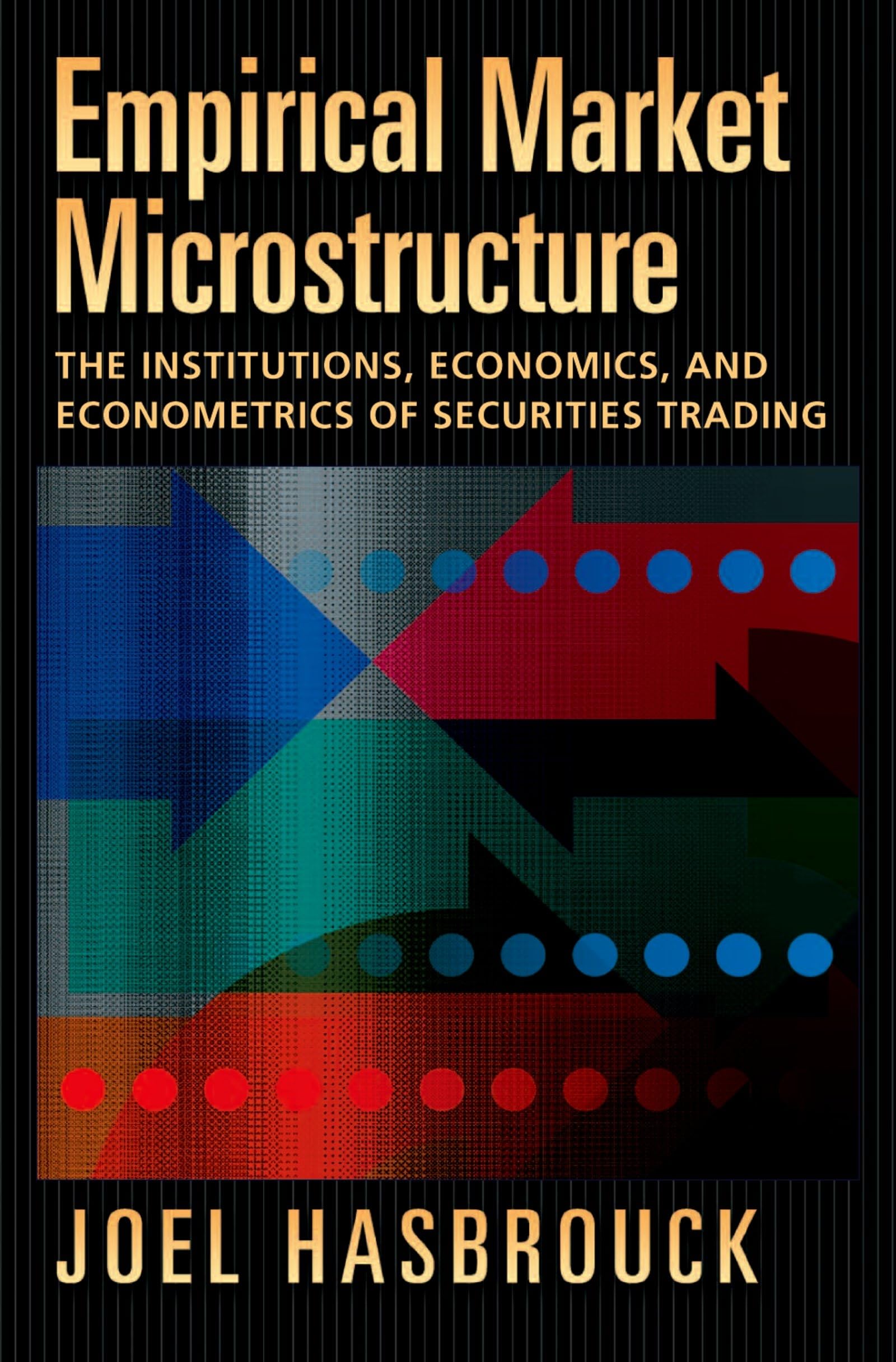
The market microstructure bible
This book should be on the shelf of anyone interested in market microstructure.Being from 2007, it's much newer than Maureen O'Hara's Market Microstructure Theory, from 1998. And you can feel that when reading. I mean, Hasbrouck is more updated, citing very recent pieces of research.
F**N
Best Market Microstructure Text in Existence!!
If you need to have one book on market microstructure, this is it!!I have nothing bad to say about this text. Great for finance phd students interested in microstructure.More applied than O'Hara.
H**G
Great first book on Empirical Market Microstrucutre
Hasbroucks book is a classic in the field and is an excellent first book for someone wishing to learn how to model the microstructure of financial markets, something that has become increasingly important in the last 10 years or so.His modus operandi is the very basic Roll model and demonstrating how this can be extended and adapted to a large number of problems. I strongly support this method of introducing someone to this vast and scattered research area, especially for students aiming to work outside of academia after graduation.The book does require some experience with time series modeling (at the level of for instance Brockwell & Davis) but other than that doesn't require much exposure to advanced math. It should be an excellent book for finance students at the early graduate level and should also be good for self study as it includes a number of good exercises (no answers though).
P**R
Empirical Market Microstructure
Nearly fifteen years has passed since the publication of Maureen O'Hara classic but, if anything, the subject became even murkier. In my opinion, the discipline of market microstructure consists of disjointed models, none of which is directly testable and numerous empirical results poorly connected between each other.The work of premier practitioner of the subject, Prof. Joel Hasbrouck (NYU), helps the reader to untangle this mess, if it is at all possible. In this respect, I will prefer it, thumbs up, to my own book "Microstructure and noise in financial markets." It is naturally skewed towards author's own results, hence, it is heavily econometric. But, unlike many original papers, math is elegant and easy to follow. Furthermore, the reference section contains incomplete but excellent bibliography, which allows the reader to follow disparate models sometimes included in the main text in sketchy details.I would not recommend this book for the first acquaintance with the subject-- for this, dependent on whether you have theoretical or practical bent-- the books by M. O'Hara and L. Harris still remain indispensable. But the student in the field will find a lot of valuable material and insights, and writing my own book, I kept "Empirical Market Microstructure..." not far from my working table.
D**N
Great academic read
If you are looking for a graduate thesis written for academia, this is your book. However, if you are looking for true applied knowledge, this is not your book. Unfortunately I made the painstaking effort of reading through this book. It is strong on theory and extremely weak on application. It is filled with references to other works and does a wonderful job summarizing those other works. In short, not a good buy unless your are doing graduate work.
A**S
Good introduction to market microstructure concepts
Provides a good introduction to basic microstructure analysis, however I feel that the material is a bit dated. Also, methods such as stochastic pdes, risk minimization and game-theoretic approaches are not touched up on at all.
G**A
Knowing the Market
The book by Professor Hasbrouck "Empirical Market Microstructure" is an excellent additon to the recent literature on market microstructure. by focussing on empirical modelling of various aspects of market microstructure, the book fills a much needed gap between high end practionaers and academia. It complements the theoretical book by Professor O'Hara, and concisely presents a great deal of empirical work done by Prof. Hasbrouck himself in this field.Ocassionally the book reads like a cook book and at times like a summary of the papers; for people who have read his earlier papers, the material sounds a bit repititive.some more effort on highlighting the differences in empirical results between equity, FX and Fixed income markets, and reconcilling with theoretical ideas would have been far more informative.
Trustpilot
1 week ago
3 weeks ago