
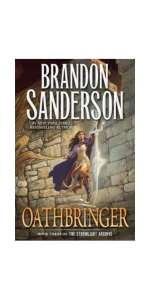
Oathbringer: Book Three of the Stormlight Archive [Sanderson, Brandon] on desertcart.com. *FREE* shipping on qualifying offers. Oathbringer: Book Three of the Stormlight Archive Review: Wonderfully-Written Third Installment in The Stormlight Archives - Oathbringer is the third installment of The Stormlight Archive, Brandon Sanderson’s highly-acclaimed series set in the Cosmere. The story has major middle-book vibes, which makes sense considering this is a 5-book series. While it may not have the panache of the first two books in the series, I thoroughly enjoyed Oathbringer. READER BE WARNED, SPOILERS FOR THE WAY OF KINGS AND WORDS OF RADIANCE ARE BELOW. If you have not read my reviews for the first two books, I recommend doing that first as there are continuing themes. When I say “panache” I mean that books 1 and 2 of the series came through like a highstorm, with so much power as to be destructive and restorative at the same time. They were wall-to-wall action, almost never allowing the reader to come up for air, finishing in fabulous style with the way everything culminated at the end of Words of Radiance. And to that I say: take my breath away. I do not need it, for the stormlight will sustain me. Oathbringer, by contrast, is a very typical middle book (if anything Sanderson writes can be called “typical”), more gambit than check chase. With the coming of the Everstorm and many secrets unlocked, Dalinar, Kaladin, et al are resetting and learning a new way of life. The main protagonists have all evolved and are occupying the ancient city of Urithiru, and the Parshmen have been freed. All of the players are moving pieces around the board, searching for an opportunity to put their opponent into zugzswang. This is a long series, and as a reader I enjoyed the break from the constant war, death, and destruction of the first two installments. The way Oathbringer is written, it gives the reader many opportunities to survey the scene, learn more about Roshar, its people and history. One way Sanderson accomplishes this is with flashback narratives, which is an underrated aspect of this series. I do not believe I mentioned this in my previous reviews, so this is a great time to do so. From a writing perspective, flashbacks are hard. If they are going to take my interest away from the main storyline, they should not overwhelm, but at the same time need to be relevant and interesting. This type of narrative can be a detriment to a book if not done well, but when an author finds a balance it can be a boon. That is exactly what Sanderson has accomplished with this seres, as the flashbacks were phenomenal in providing supplementary information, focusing on first on Kaladin and Shallan in the first two books and now Dalinar and the Parshmen in Oathbringer. To me, this provides even more depth to a series that is already overflowing with it. I think that is a good thing, as a story can never be too deep (watch Sanderson take that comment and run with it – not that the encouragement is all that necessary). Another great aspect of Oathbringer is that it really ups the ante for the rest of the series. In the first two books there is a lot of standard warfare, introducing the reader to many of the players and how their powers work. It was a really exciting start, but Oathbringer has a different feeling. The Big Bang at the end of Words of Radiance put the pieces in place to rebuild sections of the story. It is much slower than the first two books, working to a longer crescendo. At the same time, the world is entirely different now. Because the it has changed so much, and because everything is going through a bit of reset, the reader is able to learn so much about this new-age right along with the characters. And that really is the brilliance of Sanderson’s writing overall (as I have come to find), which is that is feels so interactive as the reader is able to experience every event right along with the characters. That feeling of immersion has often been what has made this series so unputdownable, and Oathbringer taking a different narrative path than the first two books in the series is helped by this immersive atmosphere. Here is the thing about the ending: I cannot talk about it. In typical Sanderson style that crescendo that has been building culminates in an unbelievable way. It is easily the best ending of the first three books, and that saying something because I felt that way about each subsequent book in the series. The fact that Sanderson continues to up the ante is impressive, and I left this book with my jaw dropped. While Oathbringer is incredibly well-done, there was one detraction I want to mention. Certain events (small[ish] ones, none of the big reveals) felt rushed to me. There is a scene at the beginning of the book that felt that way to me (if you read it you will know what I am talking about), and a few others like it along the way. I know it is hard to say in a 1,000+-page book, but I would have preferred to ruminate on certain events for a bit. It is a bit of a weird thought because Sanderson at times can be the King of Rumination, so take those words with a grain of salt. This Stormlight Archive continues to be absolutely fabulous. Oathbringer is another phenomenal entry into the series, and yet again gets my highest recommendation. It has set things up for what I expect to be an amazing second half to the series, and I am very much looking forward to Rhythm of War. Review: What a great series! - I continue to love this series and have consumed roughly 4000 pages of it in about a month. It’s well-written, full of action, laden with character development, and overflowing with interesting ideas about magic and mythology. For any sheltered fans of the fantasy genre who have not heard of this series or this author, I give it the hugest possible recommendation. I’m just sorry that I finished book #3 in the series a few months before book #4 is set to be released. The third book in the Stormlight Archive series finds the main characters all facing crises: of conscience, of memory, of their personal relationships, and, most importantly, of what they want their lives to become. Kaladin, increasing in his power as a Windrunner (one of the orders of Knights Radiant, reborn after thousands of years), faces one of his periodic bouts of self-doubt, the darkness nearly consuming him into giving up. Dalinar, King of Urithiru (the rediscovered City of Knights Radiant) and uncle to the King of Alethkar, tries to understand his role in the Radiants as a Bondsmith, facing the fracturing of the alliance of nations he formed in the last book. Shallan, betrothed to Dalinar’s son, Adolin, and a Lightweaver Radiant in her own right with the abilities to project illusions and become other people, faces difficulties in deciding which of her alter egos is really her. The supporting cast (Kaladin’s Bridge Four teammates, now Windrunners themselves; Dalinar’s former sister-in-law (and now wife), Navani; Navani’s daughter, Jasnah, seemingly returned from the dead; the Assassin in White, Szeth, somehow still alive and serving as a Skybreaker Radiant trainee; and a host of others from previous books) all face similar crises of faith. Meanwhile, the army of once-Parshendi (many of whom have been transformed into Fused, a sort of counterpart on their side to the Radiants) marches towards a confrontation with the allied forces of man, just when that alliance is crumbling and many of the alliance’s strongest supporters have disappeared into a parallel plane of existence. And along the way, the world discovers a shocking secret about the nature of the conflict that shakes the very foundations of everyone’s beliefs. The plot is incredibly intricate, with dozens of interweaving storylines that all support each other in a grand whole. With so many pages in each novel (each one ranges just above or below 1300 pages), there’s ample space to have complex arcs for every character, even the minor ones, while making sure there’s plenty of plot movement and action. There’s political intrigue, soul-searching inner conflict, pledges to higher ideals, conversations with deities, loads of fighting, and a good bit of humor (thanks to Rock, Lopen, Shallan, and Lift in particular). Even the undercurrent of racism I noted in previous reviews in this series seems to be addressed as one of the main plot points (as I thought it might), and the solution to that problem will likely be central to the later books in this series. It really is one of those books that has so much going on that it’s hard to put down. As for the mechanics, it’s incredibly tight in its editing, a few split infinitives or pronoun errors aside. Page-for-page, it’s one of the cleanest series of books I’ve read in a long time, so kudos to Sanderson and his editorial team for presenting a well-written final product. I can’t say enough good things about this series. Go read it.




| Best Sellers Rank | #13,766 in Books ( See Top 100 in Books ) #46 in Epic Fantasy (Books) #98 in Sword & Sorcery Fantasy (Books) #150 in Action & Adventure Fantasy (Books) |
| Book 3 of 5 | The Stormlight Archive |
| Customer Reviews | 4.8 4.8 out of 5 stars (73,219) |
| Dimensions | 6.55 x 2.2 x 9.6 inches |
| Edition | Illustrated |
| ISBN-10 | 076532637X |
| ISBN-13 | 978-0765326379 |
| Item Weight | 2.9 pounds |
| Language | English |
| Print length | 1248 pages |
| Publication date | November 14, 2017 |
| Publisher | Tor Books |
T**K
Wonderfully-Written Third Installment in The Stormlight Archives
Oathbringer is the third installment of The Stormlight Archive, Brandon Sanderson’s highly-acclaimed series set in the Cosmere. The story has major middle-book vibes, which makes sense considering this is a 5-book series. While it may not have the panache of the first two books in the series, I thoroughly enjoyed Oathbringer. READER BE WARNED, SPOILERS FOR THE WAY OF KINGS AND WORDS OF RADIANCE ARE BELOW. If you have not read my reviews for the first two books, I recommend doing that first as there are continuing themes. When I say “panache” I mean that books 1 and 2 of the series came through like a highstorm, with so much power as to be destructive and restorative at the same time. They were wall-to-wall action, almost never allowing the reader to come up for air, finishing in fabulous style with the way everything culminated at the end of Words of Radiance. And to that I say: take my breath away. I do not need it, for the stormlight will sustain me. Oathbringer, by contrast, is a very typical middle book (if anything Sanderson writes can be called “typical”), more gambit than check chase. With the coming of the Everstorm and many secrets unlocked, Dalinar, Kaladin, et al are resetting and learning a new way of life. The main protagonists have all evolved and are occupying the ancient city of Urithiru, and the Parshmen have been freed. All of the players are moving pieces around the board, searching for an opportunity to put their opponent into zugzswang. This is a long series, and as a reader I enjoyed the break from the constant war, death, and destruction of the first two installments. The way Oathbringer is written, it gives the reader many opportunities to survey the scene, learn more about Roshar, its people and history. One way Sanderson accomplishes this is with flashback narratives, which is an underrated aspect of this series. I do not believe I mentioned this in my previous reviews, so this is a great time to do so. From a writing perspective, flashbacks are hard. If they are going to take my interest away from the main storyline, they should not overwhelm, but at the same time need to be relevant and interesting. This type of narrative can be a detriment to a book if not done well, but when an author finds a balance it can be a boon. That is exactly what Sanderson has accomplished with this seres, as the flashbacks were phenomenal in providing supplementary information, focusing on first on Kaladin and Shallan in the first two books and now Dalinar and the Parshmen in Oathbringer. To me, this provides even more depth to a series that is already overflowing with it. I think that is a good thing, as a story can never be too deep (watch Sanderson take that comment and run with it – not that the encouragement is all that necessary). Another great aspect of Oathbringer is that it really ups the ante for the rest of the series. In the first two books there is a lot of standard warfare, introducing the reader to many of the players and how their powers work. It was a really exciting start, but Oathbringer has a different feeling. The Big Bang at the end of Words of Radiance put the pieces in place to rebuild sections of the story. It is much slower than the first two books, working to a longer crescendo. At the same time, the world is entirely different now. Because the it has changed so much, and because everything is going through a bit of reset, the reader is able to learn so much about this new-age right along with the characters. And that really is the brilliance of Sanderson’s writing overall (as I have come to find), which is that is feels so interactive as the reader is able to experience every event right along with the characters. That feeling of immersion has often been what has made this series so unputdownable, and Oathbringer taking a different narrative path than the first two books in the series is helped by this immersive atmosphere. Here is the thing about the ending: I cannot talk about it. In typical Sanderson style that crescendo that has been building culminates in an unbelievable way. It is easily the best ending of the first three books, and that saying something because I felt that way about each subsequent book in the series. The fact that Sanderson continues to up the ante is impressive, and I left this book with my jaw dropped. While Oathbringer is incredibly well-done, there was one detraction I want to mention. Certain events (small[ish] ones, none of the big reveals) felt rushed to me. There is a scene at the beginning of the book that felt that way to me (if you read it you will know what I am talking about), and a few others like it along the way. I know it is hard to say in a 1,000+-page book, but I would have preferred to ruminate on certain events for a bit. It is a bit of a weird thought because Sanderson at times can be the King of Rumination, so take those words with a grain of salt. This Stormlight Archive continues to be absolutely fabulous. Oathbringer is another phenomenal entry into the series, and yet again gets my highest recommendation. It has set things up for what I expect to be an amazing second half to the series, and I am very much looking forward to Rhythm of War.
R**S
What a great series!
I continue to love this series and have consumed roughly 4000 pages of it in about a month. It’s well-written, full of action, laden with character development, and overflowing with interesting ideas about magic and mythology. For any sheltered fans of the fantasy genre who have not heard of this series or this author, I give it the hugest possible recommendation. I’m just sorry that I finished book #3 in the series a few months before book #4 is set to be released. The third book in the Stormlight Archive series finds the main characters all facing crises: of conscience, of memory, of their personal relationships, and, most importantly, of what they want their lives to become. Kaladin, increasing in his power as a Windrunner (one of the orders of Knights Radiant, reborn after thousands of years), faces one of his periodic bouts of self-doubt, the darkness nearly consuming him into giving up. Dalinar, King of Urithiru (the rediscovered City of Knights Radiant) and uncle to the King of Alethkar, tries to understand his role in the Radiants as a Bondsmith, facing the fracturing of the alliance of nations he formed in the last book. Shallan, betrothed to Dalinar’s son, Adolin, and a Lightweaver Radiant in her own right with the abilities to project illusions and become other people, faces difficulties in deciding which of her alter egos is really her. The supporting cast (Kaladin’s Bridge Four teammates, now Windrunners themselves; Dalinar’s former sister-in-law (and now wife), Navani; Navani’s daughter, Jasnah, seemingly returned from the dead; the Assassin in White, Szeth, somehow still alive and serving as a Skybreaker Radiant trainee; and a host of others from previous books) all face similar crises of faith. Meanwhile, the army of once-Parshendi (many of whom have been transformed into Fused, a sort of counterpart on their side to the Radiants) marches towards a confrontation with the allied forces of man, just when that alliance is crumbling and many of the alliance’s strongest supporters have disappeared into a parallel plane of existence. And along the way, the world discovers a shocking secret about the nature of the conflict that shakes the very foundations of everyone’s beliefs. The plot is incredibly intricate, with dozens of interweaving storylines that all support each other in a grand whole. With so many pages in each novel (each one ranges just above or below 1300 pages), there’s ample space to have complex arcs for every character, even the minor ones, while making sure there’s plenty of plot movement and action. There’s political intrigue, soul-searching inner conflict, pledges to higher ideals, conversations with deities, loads of fighting, and a good bit of humor (thanks to Rock, Lopen, Shallan, and Lift in particular). Even the undercurrent of racism I noted in previous reviews in this series seems to be addressed as one of the main plot points (as I thought it might), and the solution to that problem will likely be central to the later books in this series. It really is one of those books that has so much going on that it’s hard to put down. As for the mechanics, it’s incredibly tight in its editing, a few split infinitives or pronoun errors aside. Page-for-page, it’s one of the cleanest series of books I’ve read in a long time, so kudos to Sanderson and his editorial team for presenting a well-written final product. I can’t say enough good things about this series. Go read it.
O**N
I’ll start this review by assuming you haven’t read the first two novels in this series. Why? Because if you have, then you don’t need me to tell you how awesome this series is and you should be either reading book three now or already have finished it. So, if you haven’t start the series the question becomes: should you invest the hundred or so hours of reading required to get through the first three in what is planned to be a ten book series? The answer is yes, yes you definitely should. The Stormlight Archives is a series with a grand vision. Written by prolific American author, Brandon Sanderson, there is so much to love about these books. The world he has created is something truly unique, which you don’t see very much of these days. The whole premise is that there are is a constant barrage of predictable storms that hammer across the world, all in the same direction. This leads the world to develop in areas protected from the buffeting winds, such as leeward sides of mountains. As well as this, the closer the land is to the storm’s origin, the more devastating the effects are. As such, most of the land is unable to support the plants and animals that we know. Instead, the author has created a new, believable, ecosystem. Trust me, this in itself is an amazing feat. But it doesn’t stop there. Fans of Brandon Sanderson will be familiar with his love of magic systems. The Stormlight Archives features its own system that, honestly, I cannot do justice to in the space of a whole article, let alone as a component of one. It involves Gods, spirits, an entire other world. And again, it works! Now, all this just covers a small part of the world building that goes into this series. There is so much depth to it all that it’s easy to immerse yourself in what is basically an incredibly alien world without thinking anything is overly strange. As if that wasn’t enough, world building isn’t even the most impressive part of this series. The absolute icing on the cake is the characters. There are a handful of POV characters, each fully fleshed out into real people. They each have their own desires, their own goals, their own character arcs. They have their own strengths and, importantly, their weaknesses. I haven’t read a book in a long time that made me care as much about the characters as this series. As a very unemotional man, even I felt my eyes getting a little watery at each character’s conflicts and actions during the climax. Personally, I believe this stems from their flaws. With a few thousand pages to work with, you get to know each character so intimately that you can relate to their desires and understand why they fail when they do. This, in turns, makes their successes so much more meaningful and emotionally satisfying. So, I realise I sound like quite the fanboy over this. It’s actually hard to pinpoint anything wrong with it but… There is one thing that really bugs me. It stems from the writing concept “show, don’t tell”, something I’ve heard Brandon Sanderson himself espouse on many podcasts. Instead of telling the reader “Sam was sad”, you show them with something like “Sam wept quietly, tears turning to mud on the dirt floor.” Yes, they both convey that the character is sad, but the second one does it in a way that includes the reader, making them associate with the feeling rather than just knowing what they’re feeling. This series kind of breaks that rule, as part of the magic system involves these spirits, called spren. There are spirits of just about everything, including emotions. So, whenever a character has a strong feeling, like pain for instance, the line “He was surrounded by painspren” appears. It just felt a little cheap to me, especially when everything else is so well written. After all that, you can probably guess that I highly recommend getting into this series. Don’t be put off by the size of the books, each one being around 1,000 pages. In fact, if you get it in ebook format you don’t even notice it. Instead, just dive in and get immersed in an amazing world filled with intriguing people.
P**E
Un 3e volume où Sanderson montre encore une fois qu'il est le maître absolu de l'Epic Fantasy. Ce 3e tome est beaucoup plus sombre que les précédents mais fait la part belle aux personnages secondaires futurs principaux des tomes à venir ( Venli et Eshonai pour le tome 4 et Szeth pour le 5, Jasnah, Renarin, Lift, Ash et Taln pour le 2e arc de 5 volumes) qui ont tous droit à leur POV. Tous les protagonistes principaux sont donc présents et ont droit à un minimum de "lignes de gloire"... ce qui signifie aussi que certains personnages prennent moins de place. C'est bien normal, c'est une saga et si l'on couvrir tous les persos proprement certains sont obligés de prendre moins de place. Kaladin notamment est relégué en 3e position... ce qui peut déplaire quand il s'agit de votre personnage préféré ( KALADIIIIIIIIIIN)... mais qui scénaristiquement se tient très bien. Pas d'inquiétude, l'histoire n'en devient que plus riche, et le fait que certains personnages soient moins mis en avant ne signifie pas pour autant qu'ils soient négligés. Le début commence avec révélations sur révélations et la dernière partie du roman est du classique Sanderson: ça virevolte de tous les côtés et il est juste impossible de reprendre son souffle avant la fin. Une petite recommandation cependant: Mieux vaux relire minimum Words of Radiance avant de se lancer. Pour ma part, j'avais relu The Way of Kings, Words of Radiance et lu Edgedancer juste avant d'entamer Oathbringer et bien m'en a pris... Car même en ayant lu The Way of Kings 3 fois, et Words of Radiance 2 fois, et bien... j'ai été surprise du nombre de sous-intrigues et de personnages que j'avais oubliés d'autant que certains personnages que nous suivons dans les interludes depuis le 1er tome se retrouve dans ce troisième tome, dans des interludes juste essentiels à la bonne compréhension de l'intrigue. Autant dire que si l'on a oublié l'existence de personnages tel que Rysn, ça diminue grandement le plaisir de la redécouvrir dans un autre interlude où l'on voit comment sa petite vie "ordinaire" se retrouve elle-même impactée par les événements sur Roshar voir quand elle même se retrouve au milieu d’événements clés à l'intrigue. Lire Edgedancer n'est pas obligatoire... mais fortement recommandé car certains personnages clés jouent des rôles importants ici... l'intrigue se comprend très bien sans, mais c'est une valeur ajoutée non négligeable... comme la lecture de Warbreaker est une forte valeur ajoutée mais pas indispensable à l'appréciation de la série ( mais alors... c'est tellement jouissif que sincèrement ce serait domage de ne pas l'avoir lu d'autant que le roman est excellent). Bref c'est E.P.I.C. Encore Bravo à l'auteur pour un volume juste flamboyant et pour sa capacité à se transcender à chaque volume.
L**I
With "Oathbringer", the beauty of the "Stormlight Archive" is in full bloom. The scope of the series is here unveiled and delivered to the reader in the most perfect way. In this thirds installment, we finally get to know more about Roshar and its different peoples, whereas the mysteries surrounding the past are deepened way more then the previous two books. Per se, maintaining the attention of the reader throughout a 1200-page book is extremely difficult, but Sanderson succeeds masterfully in doing so by capturing your interest and giving you something new every single chapter. If you read my reviews of "The Way of Kings" and "Words of Radiance", you will see that they are not enthusiastic with the warning that, maybe, I did not read them in the right moment. "Oathbringer" changed completely my perception of the series with its fantasy perfection and, now, I am really looking forward to the rest of it.
A**W
Excellent book. The story doesn't let down, the revelations, the mythology and the philosophy in Roshar and its characters keeps getting richer. Loved it.
C**E
Once you get into these books you get completely hooked. An escape from this world into a world of fantasy, brilliant.
Trustpilot
2 weeks ago
2 weeks ago


