Full description not available
K**.
Viking Culture Once Again in the Vanguard...
Fabulous read, with great facts and statistics presented in a very engaging and readable format...brings the Scandinavian countries to life, and explains simply how their way of life and economy/culture supports a vibrant and forward-thinking, as well as very successful socioeconomic society that combines both freedom, equality of opportunity in personal and professional life choices, and the basic life necessities for everyone with the cultural foundation and expectation being that for this to work, everyone that can work should...in fact, the Scandinavian countries strongly encourage this by retraining and reeducating those so that they can become gainfully employed tax-paying citizens. While it touches on all three 'Scandinavian' countries (Sweden, Denmark, and Norway), it's heavily slanted on Norway, possibly because the author's wife is Norwegian and he spent time there after their marriage, but he also explores the other two nations (Iceland and Finland) that along with the three Scandinavian countries comprise the five Nordic countries. Fascinating and compelling reading.
T**Y
A review to help you feel better
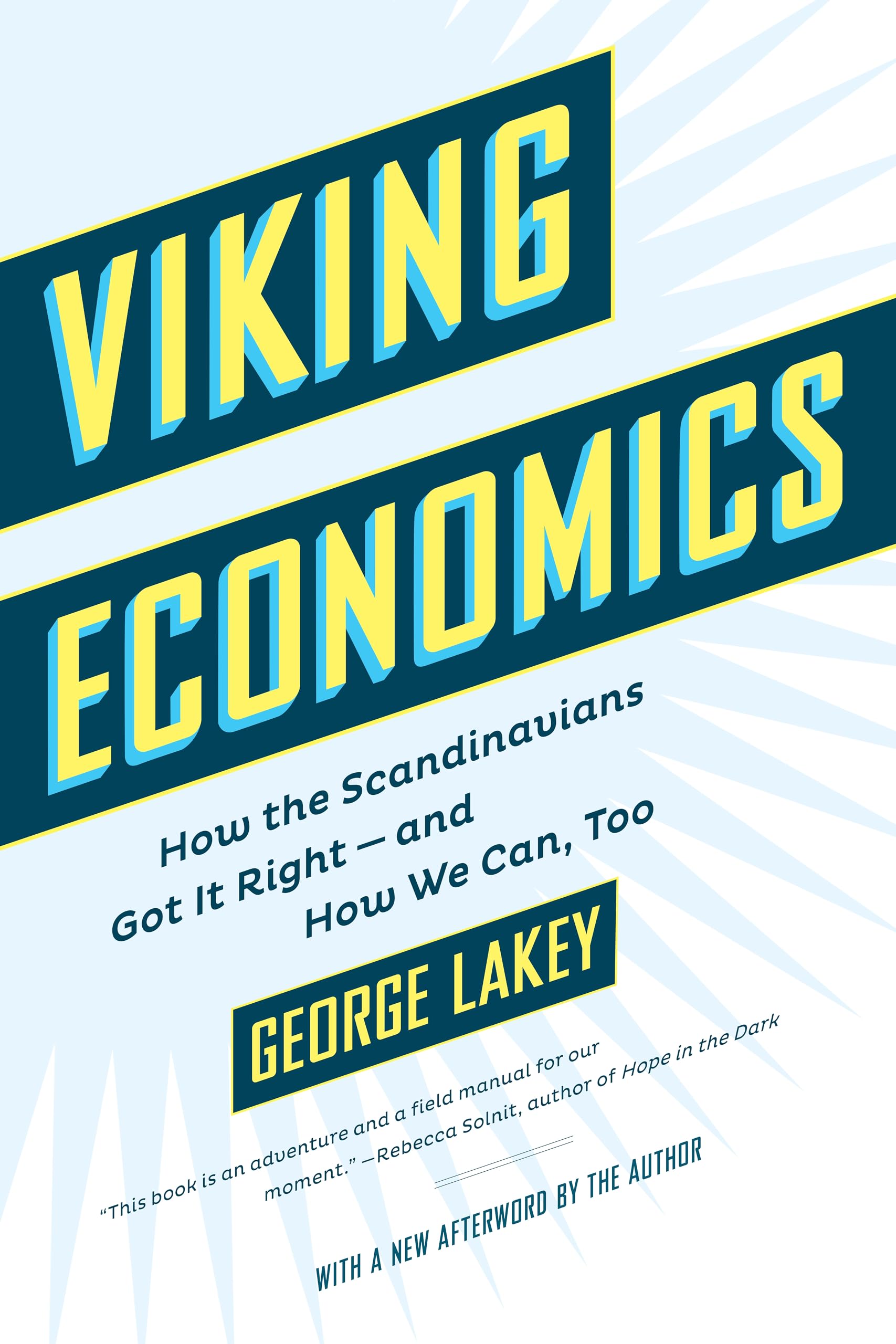
Viking Economics: how the Scandinavians got right and how we can too, by George Lakey, reviewed by Jerry WoolpyGrowing inequality is the root cause of our malaise. The symptoms are elite and corporate dominance and our inability to moderate them at the ballot box. Norway, Sweden, and Denmark provide the vision for our progressive movement. They struggled with elite dominance and authoritarianism and by dint of non-violent action overcame it to achieve meaningful democracy. Voting was not enough. Violence was not the answer. Boycotts, strikes, unionization, dogged demonstrations and other non-violent movements ultimately prevailed. Eventually the elite caved and strangely enough the economy prospered to the advantage of rich and poor alike. The goals that these tactics achieved were high taxes to support universal health care, free education, massive job training along with generous unemployment compensation. Bailouts for investors, including investment banks were prohibited. But coops and savings banks were protected. It turns out that most of the wealthy realized that high taxes were worth the cost because they lead to a stable and high growth economy with a population that trusts government. Crime and corruption were lowered to the lowest among developed nations. Only a few CEOs left the country. Startups and small business flourished as did small farms. Rural-Urban conflicts evaporated. Science, including environmental protection, global warming offsets, carbon taxes, electric cars, bikes and public transportation happened because of increased awareness and realism. Immigration and its consequent racism is and was a problem, but it was successfully mitigated and for the most part held to a minimum because of strong popular opinion and election results to the contrary. Lakey opines that Trump is a symptom not a cause. And he notes that Trump only got the votes of a quarter of the US population while the other three quarters failed to realize their majority and did not recognize the need to organize, demonstrate, start moving for things they favor: unions, taxes, health care, education, infrastructure, living wages, and jobs for everyone. Take heart friends. If the Vikings can do it so can the Yanks. Inequality is not our ultimate fate as long as we level the playing field for labor and make investors take the full risk of their investments without the protection of bailouts or tax loopholes.
H**L
Not Excellent, But Well Worth a Read
Let me say first that I am a professor of public policy, but I like to read "popular social science" that is well-grounded in real evidence and data, such as Women Don't Ask, The Big Sort, Bowling Alone, etc. I found Viking Economics very interesting and an easy read and I was glad I read it. It is thought-provoking and leads to mulling about the US economic structure. But, the chapter I was looking forward to the most--the one on whether we could do this in the US and, if so, how--was the weakest, and that disappointed me. I do recommend this book, and in fact have passed it along to my dad so that we can talk about it. But it's weaker than I wish--but I'm also not the standard audience, I'm sure. Read it, enjoy it, think about it--but don't expect too much.
M**N
George Lakey Is My New Hero!
I love economics, but have to admit that most books on the subject are a chore to slog through. Viking Economics is a notable exception. Mr. Lakey's writing style is concise, effective, and yet somehow entertaining. He destroys the myth of the Scandinavian "nanny states" by revealing that their systems are the product of ongoing, bottom-up, democratic processes. And they work extraordinarily well. The result is a group of countries that are free, equal, well-educated, healthy/secure, successful, and prosperous. Historically, their policies have only failed when they have backslid into neoliberal policies similar to those of the USA. But, they have quickly corrected. This book provides a roadmap that all nations would be better off following into the new century. Even the good old, "We're Number One!" (yeah, sure) USA.
J**X
interesting book!
I am still in the process of reading it. But the author uses a plain english laymen narrative style to address concepts. So you need to keep an open mind to understand his POV, but well worth the read to gain a new (or as he points out, old America perspective.) Well worth it.
D**D
A view of Scandanavia through rose-tinted lenses.
This book can be an informative and engaging read for people who do not already have a broad familiarity with contemporary Scandanavia. However, as a social scientist with many years of research in Sweden, I found that the book has three shortcomings: first, it skims the surface of the abundant research findings on socio-economic issues in Scandanavia; second, it's essentially a book about Norway with bits of Danish and Swedish material sort-of tacked on; third, it's largely a whitewash, with insufficient attention paid to signs of dysfunction, like bias against immigrants, the bases of support and growing political influence right wing populist movements, widespread alcohol and drug problems, etc.
Trustpilot
2 weeks ago
3 weeks ago


