Desert Online General Trading LLC
Dubai, United Arab Emirates
Desert Online General Trading LLC
Dubai, United Arab Emirates


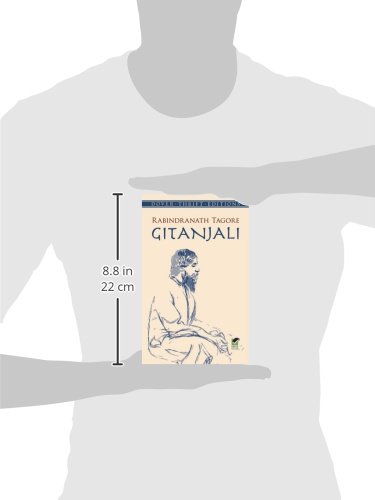
Gitanjali (Dover Thrift Editions: Poetry)
G**A
A remarkable and fascinating reinvention of a classic
We return to Birbhum, which in the nineteenth century saw the birth of the protean figure of modern Indian literature, Rabindranath Tagore: poet, playwright, songwriter, folklorist, educational reformer, Nobel laureate. In 1912, in his fifties and with a large body of Bengali-language poetry behind him, Tagore translated a book of his "austere devotional songs" into English: GITANJALI. It was a wild success and is still many readers' introduction to Tagore; but to some its Anglo-Indian English may resemble the bad, solemn early twentieth-century slush that made "mystical verse" something people would leave the state to avoid. In 2011, with a spate of Tagore anniversaries looming (the hundred-and-fiftieth anniversary of his birth in 1861; the hundredth of the publication of GITANJALI in 1912; and the hundredth of the Nobel in 1913) the British poet and translator William Radice produced a new edition of GITANJALI that would tackle some of the questions that had long attended the work. He has made a fresh translation directly from the Bengali, as Tagore's prose translations had radically altered the originals and disguised the formal variety of the collection; he has reprinted the only existing manuscript of Tagore's that Tagore had given to his friend, the artist William Rothenstein, which restores not only the original order of the poems but allows us to read them without the revisions of the printed edition, attributed largely to William Butler Yeats; and includes the version as originally published--the GITANJALI we know. It is a remarkable and fascinating reinvention of a classic, which has convinced me once again not only of the work's place in Tagore's career but of the unique quality of its vision and music. This edition is a wonderful compliment to Radice's other selection of Tagore's verse (SELECTED POEMS, Penguin, 1987), a Tagore you can recommend without apology or embarrassment, and which gives us a poet who alters your notion of twentieth-century poetry. TAGORE: AN ANTHOLOGY, edited by Krishna Dutta and Andrew Robinson (St. Martin's, 1997) gives a good selection of Tagore's prose, verse and non-fiction.Glenn Shea, from Glenn's Book Notes at www.bookbarnniantic.com
L**K
Clean, slim copy
One of my favorite texts. Book was delivered in perfect condition. Good quality paper. Very light and portable. Arrived quickly. Did not disappoint!
T**Y
Song Offerings for Tranquility
Rabindranath Tagore, one of the greatest ever multifaceted poet, writer, artist and lyricist, from Bengal was honored with a Nobel Prize in Literature in 1913 for his profound book of Song Offerings called “Gitanjali”. He thus became the first ever non European to receive this highest award in Literature in the world.As per my understanding of the book, this is one such book that should be read and at the same time heard over in song or hymn form. It is a collection of over one hundred hymns or poems that have been converted into songs in various forms. The songs/hymns are all written in praise of the Lord and mostly waiting for His arrival to take him away with him in peace. Most of the hymns are based on the loveliness of life and its beauty enhanced by the surrounding nature unveiled through the poet’s mind and heart. One can experience peace and eternal happiness while listening to these hymns. It is said that these hymns have been recourse to the Western world which was at civil strife and under deep threat of a War. Literature has been redefined in the Western world after this book has created tremors in world of English literature. Though the personification of the singer is a female (as per my understanding) in the book, I deeply appreciate the author’s ability to produce such a wonderful experience of peace and harmony in a troubled heart and mind.Positives: One would be called a genius if he understands the gist of the entire collection of song offerings at one go. A repeated audience to this great collection would carry the soul to an eternal happiness and make him/her devoid of all materialistic pleasures and troubles irrespective of age and sex. I would recommend a copy of this song book or audio device at one’s ready disposal to read or hear whenever he or she is off mood. A must read by every Indian and every citizen of the world who is at strife with his internal and external troubles.Negatives: Most of the song offerings appear to be inclined towards retirement of life and appear to those who have lost everything and just waiting for God’s arrival to take him/her away from this materialistic world.My rating is 4.5 out of 5
K**Z
A journey through the Sacred
I stumbled over these poems for the first time a few years ago and was immediately captivated by the depth,humility and transcendence of spirit that speaks through them. It is almost overwhelming and a great companion for any meditation or prayer practice. For me Tagore definitely ranks among the highest mystic master poets of all time and this collection of "songs" reminds the reader of Rumi quite a bit.Unfortunately I don't speak Sanskrit and can only imagine the " true music" created by these poems in their original tongue - and it wouldn't surprise me if the English translation is not more than a meager shadow of its original self - still...that being said the reading of it nevertheless manages to transfer its divine beauty and truly draws the reader's heart close to its spiritual source. It is almost like a healing elixir for heart and mind - and for me the impact is being in breathtaking awe of the sacred origin of all!!!For any lover of poems,prayers and sacred,verbal inspirations this is a treasure rarely found in today's world!
L**N
Disappointed!
Like the thinness of this book (easy to carry or read in bed). Unfortunately, I ordered this instead of ebook due to my poor eyesight, but too small print makes my eyes more tired. My fault not to check closely before ordering it.
S**A
Classic
It's a classic and the type of poems we don't find anymore. Very touching and beautiful words. The classic everyone should have and best to gift to someone who love poetry.
R**E
Amei
Gostei muito da escrita, o conteúdo tocou meu coração.
R**I
Boundless love for life...
Beautiful and delicate poetry. The voice of an amazing soul with a boundless love for life. Loved it down to every single word.
な**ん
心に響く稀有な詩集。
心に響く稀有な詩集だ。人生の折々に心から沸き起こって来る感情を、静かな、しかし力強い言葉で鮮やかに紡ぎ出した、時に辛く時に美しい詩の数々。読む度に人生の深淵に引き込まれてしまう。森本達雄著・訳注の「ギタンジャリ」のレヴューにも書いたが、私がタゴールの詩に興味を持ったのは、E・キューブラー・ロスの「死ぬ瞬間(死とその過程について)」の各章の扉に、彼の作品集「果実採り」、「迷い鳥たち」、「とらえがたきもの」、そして「ギタンジャリ」からの一節が紹介されているのを見てからだ。不死の病を得、人生に絶望し、救いを求めながらも死を恐れ、現状を否認し、孤立し、周りの全てに怒りを覚え、死と生の狭間で取り引きをし、抑鬱状態に苦しみながらもやがて全てを容認する、そういう人々への福音の書「死ぬ瞬間」の各章の扉に、はしなくも「福音の詩」を見い出したのだ。本書の pp. 8 – 13には、タゴールを世界に紹介した詩人イェーツの序文 (Introduction) が掲載されているが、彼が如何に「ギタンジャリ」の世界に心を掴まれ、心酔していったかが生き生きと描かれていて、感動的だ。その一部を紹介すると、I have carried the manuscript of these translations about with me for days, reading it in railway trains, or on the top of omnibuses and in restaurants, and I have often had to close it lest some stranger would see how much it moved me. These lyrics … display in their thought a world I have dreamed of all my life long. The work of a supreme culture, they yet appear as much the growth of the common soil as the grass and the rushes. (p.10., ll. 7 – 13.)If the civilization of Bengal remains unbroken, if that common mind which – as one divines – runs through all, is not, as with us, broken into a dozen minds that know nothing of each other, something even of what is most subtle in these verses will have come, in a few generations, to the beggar on the roads. (pp.10., ll.16 – 20.)At every moment the heart of this poet flows outward to these without derogation or condescension, for it has known that they will understand; and it has filled itself with the circumstance of their lives. The traveler in the red-brown clothes that he wears that dust may not show upon him, the girl searching in her bed for the petals fallen from the wreath of her royal lover, the servant or the bride awaiting the master’s home-coming in the empty house, are images of the heart turning to God. Flowers and rivers, the blowing of conch shells, the heavy rain of the Indian July, or the parching heat, are images of the moods of that heart in union or in separation; and a man sitting in a boat upon a river playing upon a lute, like one of those figures full of mysterious meaning in a Chinese picture, is God Himself. (p.11., ll.3 – 13.)どうだろう。ぜひ手に取ってお読みいただきたい。日々の生活に疲弊し、人と人との摩擦や軋轢に乾いてしまった心が、緩やかに穏やかに癒されていくこと請け合いである。
G**K
Gitanjali
I have always liked the Gitanjali and now I am pleased to have a version for my Kindle. The poems are so original and so meaningful. The only problem with this version is that it has not got a clickable index so that you can easily navigate the poems, but it isn't bad for free.
Trustpilot
2 weeks ago
2 months ago